If you’ve ever stumbled across a patch of tiny red berries nestled low to the ground while walking in a forest clearing or along a sunny path, you may have found one of nature’s sweetest hidden treasures – wild strawberries. Unlike their larger grocery-store cousins, these berries are small, delicate, and packed with flavor and medicinal value. Found across North America, Europe, and Asia, wild strawberries (Fragaria vesca) are not only a forager’s delight but also a herbalist’s ally.
What Do Wild Strawberries Look Like?
You might be wondering, what do wild strawberries look like? These plants are low-growing perennials, typically no more than 4 to 8 inches tall. They have trifoliate (three-part) leaves that are toothed and somewhat hairy. Each plant produces a single white flower on a slender stalk, followed by a tiny red fruit. The fruits are cone-shaped with visible seeds on the outer skin, just like cultivated strawberries, only much smaller.
The plants grow in clumps and spread by runners. You’ll often see them along the edges of forests, in meadows, or even popping up in yards and along trails. A good identifying tip: wild strawberry leaves resemble those of mock strawberry (Duchesnea indica), but wild strawberries have white flowers and their fruits are sweet and fragrant, unlike the bland, dry fruit of the impostor.
Are Wild Strawberries Edible?
Yes! Wild strawberries are edible, safe, and incredibly nutritious. Every part of the plant has value. The berries can be eaten fresh, dried for later use, or made into jams and teas. The leaves can be harvested and used as a mild astringent herbal tea to support digestion and menstrual health.
Unlike some wild berries that come with a cautionary note, wild strawberries are completely non-toxic and have been used in traditional medicine for centuries. If you’re new to foraging, this is a great “beginner’s berry” to get started with.
What Do Wild Strawberries Taste Like?
What do wild strawberries taste like? If you imagine the concentrated essence of a cultivated strawberry, magnified and sweetened by sunshine, you’ll get close. These berries are intensely fragrant and flavorful, with a slightly tart finish. Many foragers describe the taste as a blend of strawberry and raspberry, but with a more delicate, floral aroma.
They’re best picked early in the morning when the flavor is most vibrant. Because of their small size, they don’t store well, so enjoy them fresh or dry them soon after harvest.
How to Identify Wild Strawberries
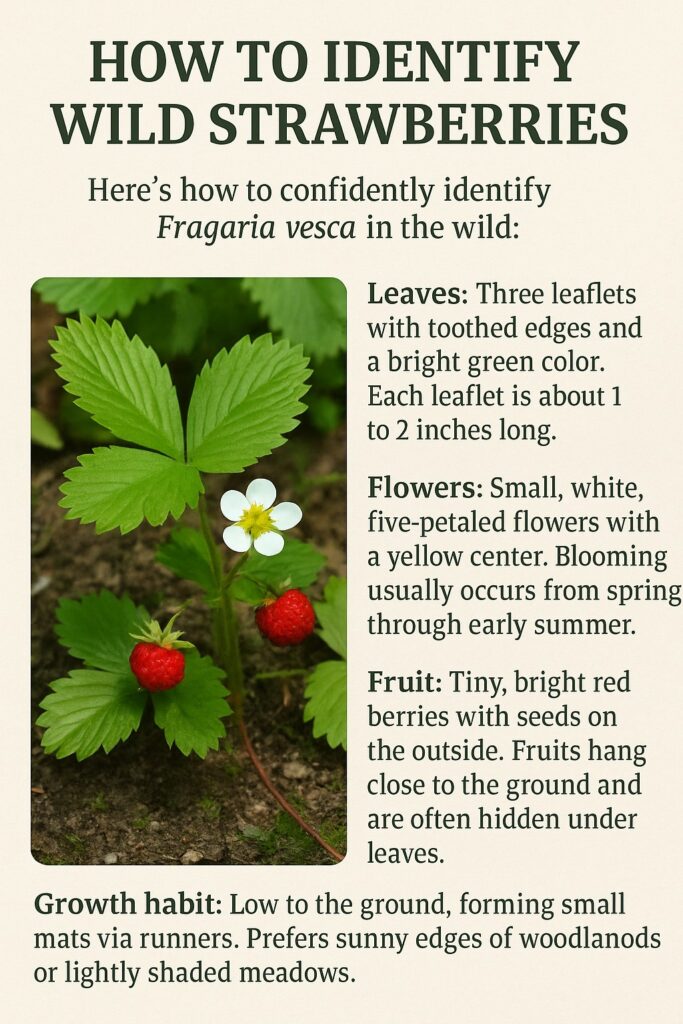
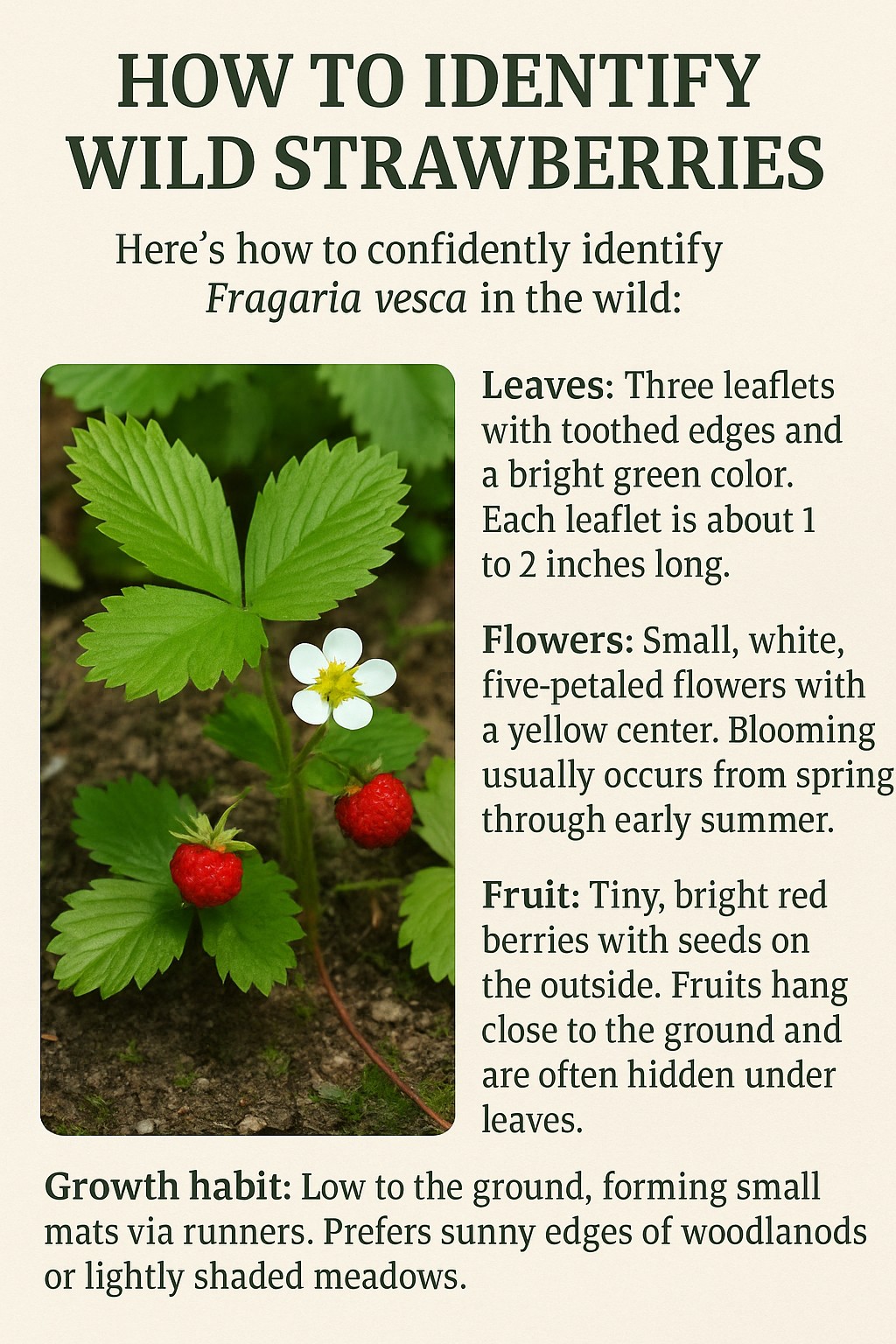
Here’s how to confidently identify Fragaria vesca in the wild:
Leaves: Three leaflets with toothed edges and a bright green color. Each leaflet is about 1 to 2 inches long.
Flowers: Small, white, five-petaled flowers with a yellow center. Blooming usually occurs from spring through early summer.
Fruit: Tiny, bright red berries with seeds on the outside. Fruits hang close to the ground and are often hidden under leaves.
Growth habit: Low to the ground, forming small mats via runners. Prefers sunny edges of woodlands or lightly shaded meadows.
Be sure not to confuse them with mock strawberries, which have yellow flowers and a tasteless, dry fruit.
You can save the following image for future reference:
Why You Want to Forage Wild Strawberries
Wild strawberries aren’t just a nostalgic summer treat, they’re a valuable herbal remedy in their own right. Here’s why you may want to add them to your foraging list:
Anti-inflammatory: The leaves contain tannins and salicylic acid derivatives, offering mild pain relief and inflammation reduction.
Digestive aid: Strawberry leaf tea has traditionally been used to ease gastrointestinal discomfort, bloating, and diarrhea.
Rich in vitamins: The fruits are loaded with vitamin C, antioxidants, and flavonoids that help boost the immune system.
Skin health: Topical applications of mashed berries or leaf infusions can support wound healing and reduce minor skin irritations.
Tonic effect: Strawberry leaves have historically been used as a general tonic to support overall well-being.
Build Your Survival Foraging Knowledge
If you’re serious about foraging and survival, it’s important to know more than just one or two edible plants. Whether you’re planning for long-term resilience or just want to reconnect with the land, a comprehensive resource is invaluable.
That’s why we recommend the Wilderness Survival Guide. It’s packed with detailed, real-world advice on edible plants, bushcraft skills, shelter building, and self-reliance tactics. If you’re learning how to survive in the wild, or just want to thrive in uncertain times, this book is a must-have for your homestead or go-bag.
Final Thoughts
Wild strawberries are a shining example of how nature provides beauty, nourishment, and healing in even the smallest packages. Knowing how to identify wild strawberries, understanding what they taste like, and recognizing that they are edible gives you access to one of the most delightful gifts the forest has to offer.
Whether you forage for their fruit or steep their leaves into a soothing tea, Fragaria vesca reminds us that herbal medicine doesn’t have to be complicated or exotic, it just has to be real.
So next time you’re walking in a quiet glade or sunny trail, keep your eyes low and your heart open. Wild strawberries might be closer than you think.
We use cookies to ensure that we give you the best experience on our website. If you continue to use this site, we will assume that you are happy with it.
Functional Always active
The technical storage or access is strictly necessary for the legitimate purpose of enabling the use of a specific service explicitly requested by the subscriber or user, or for the sole purpose of carrying out the transmission of a communication over an electronic communications network.
Preferences
The technical storage or access is necessary for the legitimate purpose of storing preferences that are not requested by the subscriber or user.
Statistics
The technical storage or access that is used exclusively for statistical purposes.The technical storage or access that is used exclusively for anonymous statistical purposes. Without a subpoena, voluntary compliance on the part of your Internet Service Provider, or additional records from a third party, information stored or retrieved for this purpose alone cannot usually be used to identify you.
Marketing
The technical storage or access is required to create user profiles to send advertising, or to track the user on a website or across several websites for similar marketing purposes.