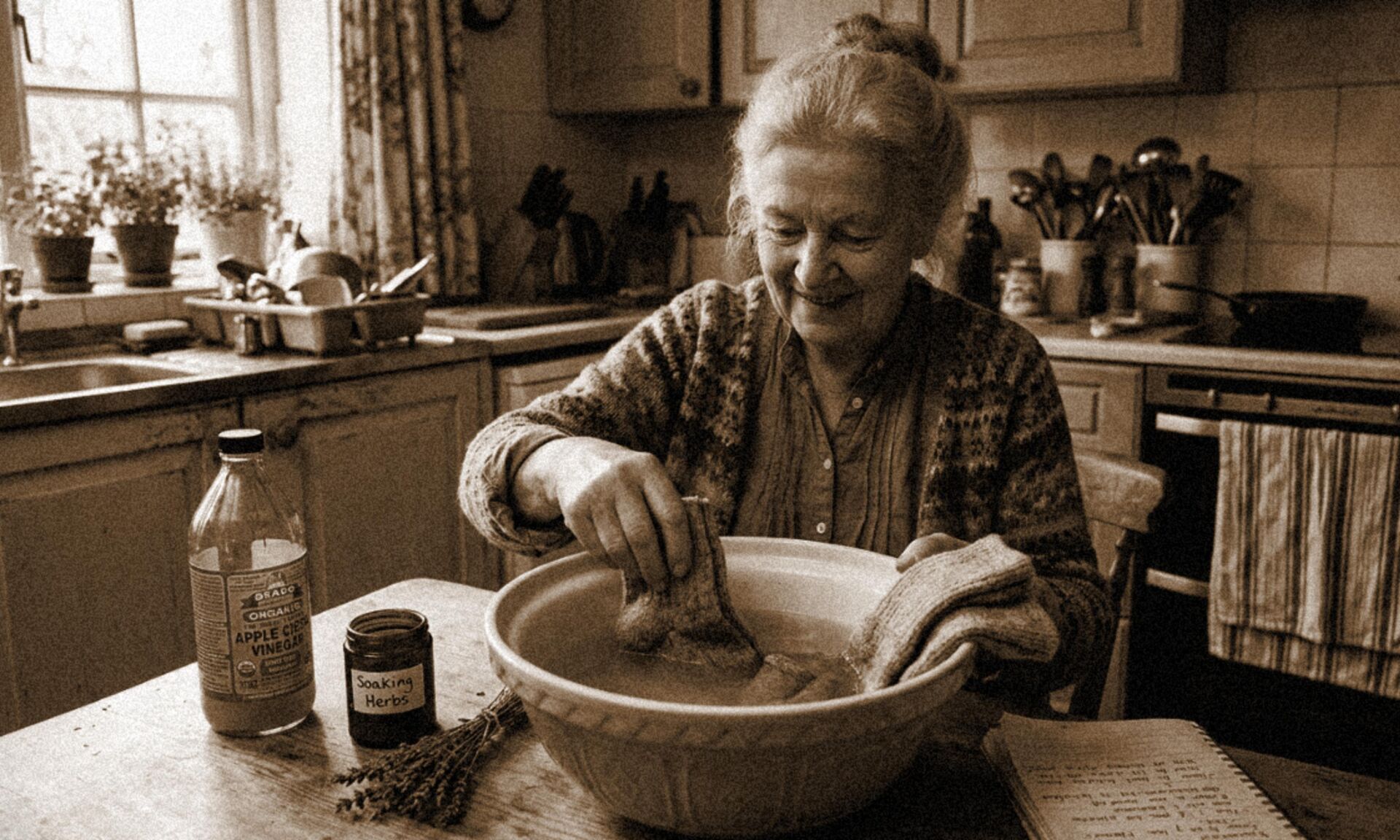
Your grandmother probably did something that seemed completely bizarre: she’d soak socks in apple cider vinegar and make you wear them when you had a fever or foot problems.
You thought she was crazy. Turns out, she was onto something.
While doctors were dismissing it as folklore, researchers were quietly discovering that apple cider vinegar’s main ingredient—acetic acid—is a powerful antimicrobial that can kill or inhibit germs. Laboratory studies now confirm what Grandma somehow knew: vinegar has genuine antibacterial and antifungal properties useful for skin issues and wound care.
Here’s what’s even more interesting: a recent BMC Microbiology study found that a 5% acetic acid solution completely wiped out Candida albicans (a common yeast) on surfaces. Another in vitro test showed that high-acid vinegar samples prevented the growth of both Candida yeast and bacteria altogether.
So when Granny put on those damp ACV socks, she wasn’t engaging in superstition—she was giving you a mild antiseptic treatment that modern science is only now validating.
Let me show you exactly how this works and how to use it safely.
How ACV Actually Works on Your Skin
Apple cider vinegar is mostly water plus acetic acid—the same compound that preserves pickles and gives vinegar its tang. Even at low concentrations, acetic acid stresses or kills microbes.
This is why vinegar socks can help fight foot infections like athlete’s foot or toenail fungus, which are caused by fungi. The acidic environment makes your skin inhospitable to these organisms.
A Cleveland Clinic podiatrist explicitly recommends a 2:1 water-to-vinegar foot soak for smelly feet, noting that the vinegar “makes your skin inhospitable to bacteria.” By extension, it slows down fungi too, since athlete’s foot often coexists with bacterial overgrowth.
But here’s the critical detail: Grandma’s remedy used proper concentrations. Modern studies using very dilute ACV (0.5% acetic acid) found no significant changes. That weak mix doesn’t do much. But stronger vinegar—what your grandmother actually used—is a different story.
After using a remedy to fight a fungal infection, your skin may feel dry, irritated, or sensitive as it is regenerating actively. This salve is essential for restoring balance and soothing the damage.
The infused herbs—like calendula and plantain—moisturize, reduce inflammation, and promote healing, while beeswax locks in hydration to prevent cracking and reinfection. With its calming lavender oil and skin-nourishing vitamin E, this salve ensures your skin recovers smoothly, leaving it healthy and protected.
What Grandma’s Foot Soak Actually Treats
Athlete’s Foot & Nail Fungus: A 2017 dermatology report evaluated vinegar sock soaks specifically for tinea pedis (athlete’s foot) and onychomycosis (nail fungus). The fact that medical journals are investigating it shows legitimate scientific interest. The acid environment makes it harder for fungi to thrive.
Plantar Warts: Cleveland Clinic notes that ACV contains acetic acid plus malic acid (an AHA) which “kills off bacteria” and gently exfoliates thick skin. Applied twice daily over weeks, you can literally scrub or peel away the wart. The acid dissolves virus-infected tissue layer by layer.
Foot Odor: Smell comes from bacteria breaking down sweat. Dr. Joy Rowland of Cleveland Clinic advises a foot bath of 1 part vinegar to 2 parts water for 15-20 minutes once weekly to reduce smell. You can use white or apple cider vinegar interchangeably.
Fever Reduction: Some Eastern European and Mediterranean traditions claim vinegar-soaked socks “draw out” fever. One trial found that a warm vinegar compress lowered children’s fevers more than plain warm water. Whether socks do the same is unproven, but the cool, acidic liquid against skin likely provided comfort and encouraged blood flow.
General Foot Care: The American Podiatric Medical Association notes that “Apple cider vinegar is one of the best foot soaks… it has many beneficial properties, from helping to slough off dead skin to fighting fungus and odor.” A dilute ACV bath softens calluses and makes skin more supple.
Let’s be clear: rigorous clinical evidence is still limited. Cleveland Clinic warns that no one has proven ACV soaks cure athlete’s foot or nail fungus. One doctor bluntly states that “nobody’s really researched” ACV’s effect on foot fungus.
What we know for certain:
Lab studies show vinegar kills microbes and fungi
Small trials show benefits for warts and odor
Anecdotal reports show people feeling relief
Medical professionals recommend it for specific uses
What we don’t have:
Large-scale clinical trials for foot fungus
Definitive proof it cures nail infections
Evidence it works as well as prescription antifungals
In other words: big promises backed by limited but genuine science, with big caveats about what it can’t do.
Usnea and its Antifungal PROVEN Actions
But there’s good news: usnea, a natural remedy often called “old man’s beard,” can help you take control. Packed with a powerful antifungal compound called usnic acid, usnea works by breaking down fungal cell walls, stopping their growth, and supporting your immune system to fight back. Whether it’s a topical skin issue or a systemic fungal infection, a usnea tincture is a must-have in your arsenal.
If you want to harvest usnea yourself, make sure to do it responsibly to protect this slow-growing lichen. Look for usnea on fallen branches after storms rather than pulling it from living trees to avoid harming the environment.
Always check for its stretchy white core to correctly identify it and avoid confusing it with similar lichens. Since usnea absorbs toxins from its surroundings, only gather it from clean, unpolluted areas to ensure it’s safe and effective.
Once you’ve collected your usnea, dry it thoroughly before using it. To make a tincture, use high-proof alcohol to extract its active compounds most effectively.
If you want to skip this long and time-consuming process and you’d rather get a ready-made spray, this is the only trusted source I recommend sourcing it from. After many unsatisfying attempts from multiple suppliers, I finally found the best apothecary here.
Why wait for the problem to worsen when you can tackle it head-on with a proven natural solution? Don’t let a simple infection turn into a bigger issue—usnea has your back.
How to Use ACV Socks Safely (This Part Matters)
Vinegar is acidic. Always dilute. Undiluted ACV can cause chemical burns.
The Safe Recipe:
Mix 2 parts warm water to 1 part vinegar (use full-strength 5% ACV)
Soak socks or a basin in this solution for a few minutes
Wring out socks and wear for 15-30 minutes while damp (or just soak feet in basin)
Dry feet thoroughly afterward—don’t leave them damp
Critical Safety Rules:
Do NOT use on open cuts, sores, or seriously cracked skin. Even diluted vinegar can irritate or burn.
If feet start stinging or burning, remove socks immediately and rinse
Don’t soak more than once daily; stop if redness occurs
If you have skin breaks or severe infection, skip home soaks and see a doctor
Cleveland Clinic explicitly warns: Foot fungus can spread or worsen if left untreated. ACV should never replace proper medical treatment for serious infections.
If making remedies at home isn’t an option for you, don’t worry—you can still enjoy the benefits of usnea with a convenient usnea tincture spray.
This ready-made spray is perfect for topical use, especially on fungal infections, where it works to disinfect and soothe the skin with its natural antimicrobial properties. Beyond that, usnea spray is a fantastic, natural alternative to store-bought disinfectants that often contain harsh chemicals harmful to your skin.
Whether you’re dealing with minor cuts, scrapes, or even as a gentle hand sanitizer, this spray is a safer, skin-friendly solution you’ll feel good about using.
Enhanced Recipe Options:
Add handful of Epsom salt or baking soda for extra cleaning power
Use warm (not hot) water so the mix isn’t shocking
Frequency: Once daily or a few times weekly maximum
If problems persist (itching, pain, spreading rash), see a podiatrist
When Grandma’s Wisdom Needs Modern Medicine
ACV socks work best for mild foot odor, early-stage athlete’s foot, softening calluses, treating plantar warts, and general foot care.
For severe fungal infections, nail fungus that won’t improve, spreading rashes, open wounds, or diabetes-related foot issues, it’s smart to see a doctor alongside using these remedies.
High fevers—especially in children—should always be evaluated by a healthcare provider. Grandma’s remedy harnesses real antimicrobial action and provides genuine relief, but pairing it with professional guidance when needed is the wisest approach.
The Difference Between Helpful and Harmful: Why Strength Matters
Here’s what most people don’t realize: making remedies incorrectly can either waste your time or hurt you.
Too weak? It won’t help at all. You’ll think natural remedies don’t work when really, you just didn’t extract the compounds properly.
Too strong? You risk chemical burns, skin damage, or worse.
This is why The Lost Remedies Academy exists. Nicole teaches you the exact ratios, extraction methods, and safety protocols—on video, step by step—so your remedies actually work without harming you.
You’ll learn:
Proper dilution ratios (so you don’t burn your skin)
Which extraction method to use for each plant (water, alcohol, oil)
How to test strength before using
Safety guidelines for every remedy
Grandma knew these things instinctively because she learned from her grandmother. But that knowledge was lost. Nicole is bringing it back.
Your grandmother wasn’t practicing superstition. She was using acetic acid—which science now confirms kills microbes in laboratory tests, helps with warts, reduces odor, and fights fungal infections.
The American Podiatric Medical Association recognizes vinegar soaks. Cleveland Clinic doctors recommend it. Studies validate its antimicrobial properties.
This is a low-risk home remedy with genuine antiseptic and softening effects when used correctly. Think of it as Grandma’s TLC with a scientific twist.
Start with proper dilution, watch for irritation, and know when to add professional care. Science is finally catching up to Grandma. And as usual, she was right.
Every Remedy Your Grandmother Knew (Before Big Pharma Buried Them)
Your grandmother had remedies for everything. Vinegar socks for foot fungus. Honey for wounds. Willow bark for pain. Herbs for every ailment.
Then Big Pharma came along and convinced the world that only patented chemicals work. They buried traditional knowledge, called it “folklore,” and replaced your grandmother’s apothecary with a pharmacy full of synthetic drugs.
The Forgotten Home Apothecary is a collection of all those lost remedies—250 of them—organized by body system so you can flip straight to what you need.
Written by herbalist Dr. Nicole Apelian after decades of research into what our ancestors used before pharmaceuticals enslaved us with chemicals:
Nature’s Betadine
Grandma’s Antibiotic in a Jar
Amish Amoxicillin
Nature’s Aspirin
Anti-Fungal Salve
Vinegar Socks
Plus 244 more remedies your grandmother knew—with step-by-step instructions, color photos, and exact measurements.
This isn’t “alternative medicine.” This is the medicine that worked for thousands of years before chemical companies patented synthetic versions and called them “better.”
We use cookies to ensure that we give you the best experience on our website. If you continue to use this site, we will assume that you are happy with it.
Functional Always active
The technical storage or access is strictly necessary for the legitimate purpose of enabling the use of a specific service explicitly requested by the subscriber or user, or for the sole purpose of carrying out the transmission of a communication over an electronic communications network.
Preferences
The technical storage or access is necessary for the legitimate purpose of storing preferences that are not requested by the subscriber or user.
Statistics
The technical storage or access that is used exclusively for statistical purposes.The technical storage or access that is used exclusively for anonymous statistical purposes. Without a subpoena, voluntary compliance on the part of your Internet Service Provider, or additional records from a third party, information stored or retrieved for this purpose alone cannot usually be used to identify you.
Marketing
The technical storage or access is required to create user profiles to send advertising, or to track the user on a website or across several websites for similar marketing purposes.