
Blood Sugar Herbal Gummies
Your blood sugar could be climbing, and you might not even realize it.
That’s the scary part.
You wake up, eat breakfast, go about your day, and feel perfectly fine.
But inside your body, something could be happening without any obvious warning signs.
And when blood sugar stays too high for too long, your heart, kidneys, nerves, and even your eyesight can suffer.
The problem? Many people don’t pay attention until their doctor tells them something is wrong.
But here’s something I find fascinating.
Long before pharmacies filled their shelves with medications, our ancestors were already using certain seeds, flowers, and spices to support their health.
And some of those same plants have a long history of use for blood sugar and heart health.
Today, I’m going to show you how to combine four of them into homemade herbal gummies.
They’re easy to make, naturally colorful, and much more enjoyable than swallowing another supplement.
But first, there’s something you should understand about your blood sugar.
What Happens When Your Blood Sugar Gets Too High?
Every time you eat bread, pasta, or something sweet, your body turns carbohydrates into glucose for energy.
Insulin helps move that glucose from your blood into your cells.
But when your body stops responding properly to insulin, sugar can build up in your bloodstream.
Over time, this can damage your heart, kidneys, nerves, and even your eyesight.
And here’s the scary part: You might feel perfectly fine while your blood sugar is getting worse.
That’s why you shouldn’t wait for symptoms to start paying attention.
Especially these four.
Most people wait until their blood sugar is already a problem before they change anything.
But there are small warning signs, foods, and everyday habits worth paying attention to long before that.
And sometimes the biggest difference comes from knowing what to eat, what to avoid, and what to do every single day.
That’s why I keep The Holistic Guide to Wellness close.
It doesn’t just throw a few herbs at the problem. It gives you a step-by-step daily protocol for common health issues, including metabolic and blood-sugar concerns.
You’ll see what to focus on morning, afternoon, and evening, from food and herbs to movement and other daily habits.
👉 Grab the guide here and see the full protocol.
1. Fenugreek: The Forgotten Blood Sugar Seed
If you’ve never heard of fenugreek, you’re missing out on a fascinating little seed.
For centuries, people have used fenugreek in traditional herbal medicine, particularly for digestion and blood sugar support.
And there’s a good reason herbal enthusiasts still talk about it today.
Fenugreek contains soluble fiber, which can slow carbohydrate absorption and may help support healthier blood sugar responses.
It also has a slightly sweet, maple-like aroma.
But don’t let that fool you. The seeds taste quite bitter!
That’s why I prefer using them in an herbal infusion rather than chewing them directly.
And you’ll only need one teaspoon for our recipe.
And this is where owning The Lost Book of Herbal Remedies I can almost work against you.
Because you may think you already have Nicole’s complete plant knowledge.
You don’t.
There simply wasn’t enough room in the first book.
That’s why Nicole created The Lost Book of Herbal Remedies II — after listening to what readers of the first book said they were still missing.
It adds 139 completely different useful plants and more than 207 new step-by-step remedies that aren’t in your first book.
And identification has been improved too.
You get larger in-field pictures, extreme close-ups of the important plant parts, clearer harvesting instructions, warnings, known interactions, and individual recipes right beside the plants you’re learning about.
So if Book I is already sitting on your shelf, I really think Book II belongs beside it.
Otherwise, you’re still missing a huge part of Nicole’s work.
👉 Click here to complete your Lost Book of Herbal Remedies collection.
2. Ceylon Cinnamon: The Spice You Shouldn’t Overlook
You probably have cinnamon sitting in your kitchen right now.
But how often do you think about it as an herb?
Our ancestors valued cinnamon for far more than its wonderful smell.
It was traditionally used to warm the body, support digestion, and bring comfort after meals.
Today, it’s also widely discussed for its role in blood sugar management.
One thing I recommend is choosing Ceylon cinnamon.
Unlike the more common cassia cinnamon, Ceylon contains much less coumarin, a naturally occurring compound that can be harmful to the liver in excessive amounts.
And here’s another advantage.
Ceylon cinnamon has a delicate sweetness that works beautifully in homemade gummies.
3. Hibiscus: Don’t Forget About Your Heart
Here’s something you shouldn’t overlook.
Blood sugar problems and heart problems often go hand in hand.
That’s one reason I wanted to include hibiscus.
For generations, people across Africa, the Caribbean, and other parts of the world have enjoyed this deep-red flower as a traditional herbal drink.
And hibiscus has attracted attention for its potential to support healthy blood pressure.
Plus, it gives our gummies their gorgeous ruby-red color and refreshing tart flavor.
No artificial coloring needed!
Something I find interesting is that many of these remedies stayed alive longest in places where people still passed plant knowledge directly from one generation to the next.
When there wasn’t a pharmacy around every corner, you had to know what was growing around you and what you could actually make with it.
And a lot of that knowledge has slowly disappeared from everyday life.
That’s one reason I keep The Lost Skills of Independence around.
There’s an entire section dedicated to Lost Healing Skills, including old preparations for digestion, immunity, pain, the liver, and even cardiovascular support.
For the heart alone, you’ll find recipes such as:
And that’s only one tiny part of the book.
It also shows you how to grow and preserve food, source and store water, make things yourself, prepare remedies, and relearn practical skills people once depended on every day.
Because knowing which herb helps is useful.
Knowing how to take care of yourself when nobody else can do it for you is something else entirely.
👉 Click here to see the Lost Healing Remedies and the other 200 skills Claude Davis preserved.
4. Ginger: More Than Something for an Upset Stomach
You’ve probably reached for ginger tea when your stomach felt uncomfortable.
And you’re not alone.
Ginger has been used for generations to support digestion and ease nausea.
It also contains natural compounds called gingerols, which are being investigated for their effects on inflammation and metabolic health.
But there’s another reason I love adding ginger to this recipe.
It makes everything taste better.
Fenugreek can be bitter. Hibiscus is tart.
Ginger brings a little warmth that balances both flavors.
Now that you know why I chose these ingredients, let’s put them together.
How to Make Blood Sugar Herbal Gummies
These aren’t your ordinary store-bought gummies.
No corn syrup. No artificial dyes. And no need to add refined sugar.
Just a few familiar herbal ingredients transformed into something you can make in your own kitchen.
What You’ll Need

For the herbal infusion:
- 1 cup water
- 1 tablespoon dried hibiscus
- 1 teaspoon fenugreek seeds
For the gummies:
- ¾ cup strained herbal infusion
- 1 teaspoon Ceylon cinnamon
- ½ teaspoon ground ginger
- 1 tablespoon fresh lemon juice
- 3 tablespoons unflavored gelatin
- A little monk fruit sweetener or stevia, to taste
Step 1: Brew Your Herbs
Bring one cup of water to a gentle boil, then remove it from the heat.
Add your hibiscus and fenugreek seeds.
Cover and steep for 10–15 minutes.
You’ll notice the water turning a beautiful deep red.
Strain the herbs and measure ¾ cup of the infusion. Add a little water if needed.
Step 2: Add Your Spices
While the infusion is still warm, stir in your Ceylon cinnamon, ginger, and lemon juice.
Add a little monk fruit or stevia if you prefer a sweeter gummy.
You want something pleasantly tart, not overwhelmingly bitter.
Step 3: Prepare the Gelatin
Let the herbal mixture cool until it’s no longer hot.
Slowly sprinkle the gelatin over the surface and leave it for about five minutes.
Then gently warm the mixture over low heat, whisking until the gelatin dissolves completely.
Avoid boiling it.
Step 4: Make Your Gummies
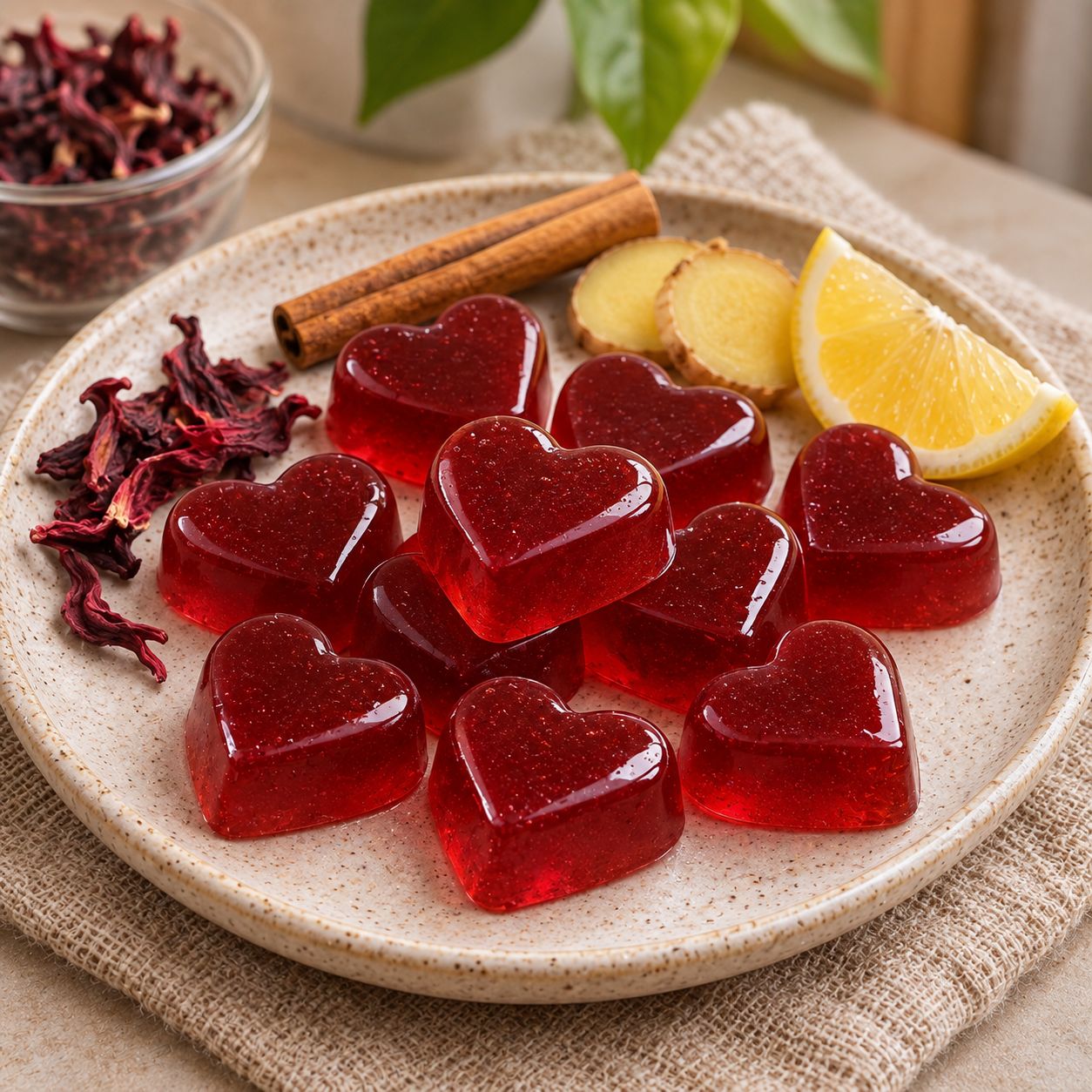
Pour the mixture into silicone gummy molds.
Place them in the refrigerator for about two hours, or until firm.
Once set, gently remove your gummies.
And that’s it!
You’ve just made your own herbal gummies using four plants with fascinating traditional histories.
Store them in an airtight container in the refrigerator and enjoy them within three to four days.
Because these are homemade, they shouldn’t be treated like shelf-stable candy.
And if making gummies every few days feels like too much work, I get it.
You have to brew the herbs, measure everything, prepare the gelatin, pour the molds, refrigerate them… and then start all over again a few days later.
If you want something easier and more convenient, I’d go with a ready-made herbal blend instead.
This one combines hawthorn, Tulsi, Fenugreek, and Bilberry for cardiovascular and metabolic support, so you can simply keep it on hand and use it without turning your kitchen into a mini apothecary every week.
If You Don’t Learn This Now… Will You Remember It When You Actually Need It?
You just learned how four ordinary plants can be turned into something completely different.
But knowing their names is only part of the skill.
Will you remember what to use, how much, which part of the plant you need, and how to prepare it six months from now?
That’s the problem.
Knowing herbs means little unless you know how to identify them, prepare them, and actually turn them into remedies.
And that’s exactly what Nicole teaches inside The Lost Remedies Academy.
She doesn’t just hand you another list of plants.
You actually watch her make remedies such as:
- 🌿 Pancreas Drops
- 🩸 Glucose Guardian Blend
- 🍵 herbal preparations for inflammation and metabolic support
- 🌱 tinctures, teas, extracts, salves, syrups, and other remedies you can recreate yourself
And, more importantly, she teaches you how to recognize medicinal plants correctly and separate them from dangerous lookalikes.
Because recipes can disappear from the internet.
A skill you actually learned is much harder to lose.
👉 Click here to join The Lost Remedies Academy and learn directly from Nicole.
Some Knowledge Is Too Valuable to Forget
I think we’ve become far too quick to overlook the plants growing around us.
We walk past herbal remedies in grocery stores without giving them a second thought.
Meanwhile, our grandparents knew how to turn ordinary seeds, roots, and flowers into useful homemade preparations.
That doesn’t mean modern medicine has no place. Far from it.
But it does mean traditional herbal knowledge still deserves a place in our kitchens.
And that’s exactly why I wanted to share these gummies with you.
Not because a handful of herbs can magically fix your blood sugar.
But because understanding what you’re putting into your body matters.
And sometimes, rediscovering an old remedy starts with something as simple as opening your spice cabinet.
You may also like: 
Lavender Lemonade Recipe – The Herbalist’s Guide to Making It Right
Never Do This Before Going To Sleep (Video)
Does Herbal Tea Have Caffeine? An Herbalist’s Guide to What’s Really in Your Cup
DIY Bath Salts: An Herbalist’s Guide to Making Your Own Soothing Soaks