

Burdock – The Complete Guide to This Powerful Root’s Uses, Benefits, and Safety
Burdock (Arctium) is a biennial plant that belongs to the Asteraceae or Daisy family and the Thistle group and is related to sunflowers. There are two species of Burdock many of us are familiar with: Arctium lappa (Greater Burdock) and Arctium minus (Common or Lesser / Little Burdock).
Greater Burdock has many names including Lappa, Edible Burdock, Thorny Burr, Love Leaves, Cocklebur, and in Japan, it is called Gobo.
Interestingly, the tenacious burrs produced by Burdock were the inspiration for the invention of Velcro by Swiss inventor Georges de Mestral.
[lwptoc]The History of Burdock

In addition, other parts of the Burdock plant have traditionally been used to purify the blood and treat a range of skin ailments.
⇒ The Complete Map of Edible Plants: Find Out What You Have in Your Area! (Video)
Where This Plant is Found
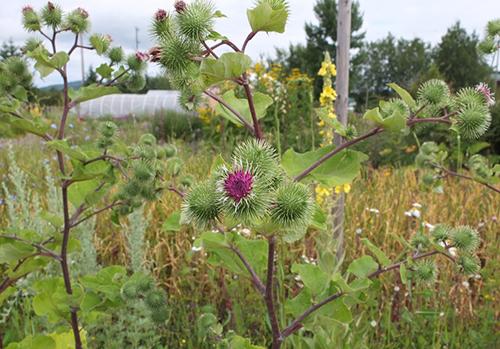 Burdock is native to a broad sweep of temperate regions ranging from Scandinavia in the north to the Mediterranean in the south, east through to Russia from the UK, and the Middle East extending into China, India, and Japan. It has now been naturalized almost worldwide except in the southern US and it is grown as a commercial food crop in Japan.
This plant particularly enjoys growing where the soil has been disturbed such as roadsides, waste ground, and fields. It also likes to grow where the soil is damp or next to rivers and streams. It spreads rapidly and is listed as an invasive weed in several areas.
Related: I Used To Cut This Plant…Until I Saw This!
How to Identify Burdock
These plants are impressive in stature with mature Greater Burdocks reaching from 5 to 9 feet / 1 ½ – 2 ¾ meters. The stem is branched, and the entire plant is pale green. The flowering season is from late summer well into autumn.
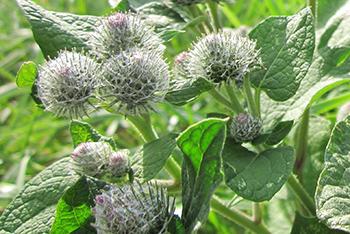
 Leaf: The leaves are green on top and whitish on the underside due to the down that covers them. Mature Greater Burdock leaves at the base of the plant can reach 100 centimeters / 38 inches in length. The leaves get smaller the higher they are on the plant.
Each leaf is attached to the stem by a strong stalk. Larger, mature leaves are heart-shaped, and the younger, higher ones are smaller and egg-shaped. They also are less covered in down.
- Stems: The lower leaf stems on the Greater Burdock are solid and have marked grooves like those in celery stalks. Lesser Burdock stems or stalks are hollow and have a shallow groove down the center of the stalk.
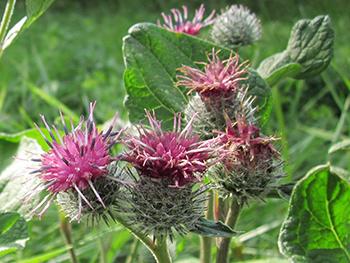
 Flower: The flowers closely resemble those of thistles. The petals appear in tufts from a ball-shaped bract. They range in color from pink to purple. The stamens are a darker color than the petals.
Each flower is 1 – 3 centimeters / 0.4 – 1.2 inches across; the flowers of the Great Burdock are larger than those of the Common Burdock. Each flowerhead is made up of multiple, hooked bracts which dry into the familiar burs.
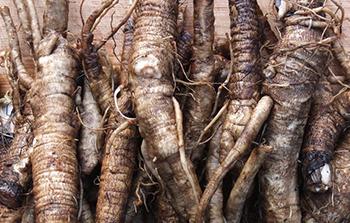
 Root: This plant has a tap root that reaches lengths of 1 meter / 39 inches. The exterior of the root may be greenish-brown or almost black in color.
The outer skin is thin and, when cooked, the root is similar in texture to parsnip.
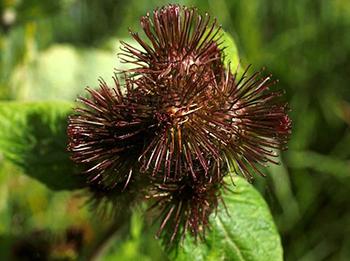
 Seeds: Burdock in part gets its name from the hooked burs or seeds that it produces.
These get attached to animal fur, clothing, etc., and are carried off that way. Once these burs are deposited in suitable environments, they germinate the following spring.
Typically for a biennial plant, the first year’s growth only consists of a rosette of basal leaves, and Burdocks don’t have flowers or their characteristic burrs until their second year.
How to Grow Burdock
It’s easy to grow Burdock from seed as they germinate readily, but ideally, you need to prepare the soil first.
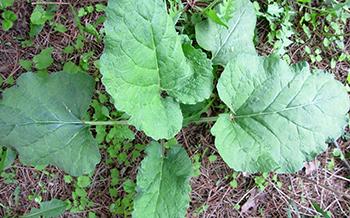
 Preparation: Select an area that is in full sun. Work the soil well and dig in humus (such as compost, rotted leaves, etc.) and a nitrogen-rich fertilizer. Using some phosphorous will result in strong root growth.
- Planting: Seeds/burs can be planted in autumn or early spring. If you plant in autumn, the seeds should be placed at a depth of 1 inch / 2 ½ centimeters and half that depth in spring. Because these plants get so big, they should be planted 1 ½ – 3 feet or 45 – 90 centimeters apart. They will germinate after 7 to 14 days.
- Care: Remove weeds that grow around or between your plants as they ‘steal’ soil nutrients. Also, snails and slugs love young Burdock plants so you will need to protect them. Using liquid fertilizer will promote ongoing health.
You certainly don’t need to prune Burdock but keep an eye on it in terms of pests or diseases and keep the soil moist.
Related: Burdock: The Annoying Weed That Can Save Your Life
How to Harvest This Plant
Generally, Greater Burdock is better than Common Burdock. Harvesting of both, though, takes place throughout summer and into the autumn. It’s important to note that the root is the plant part that is used in healthcare and cooking.
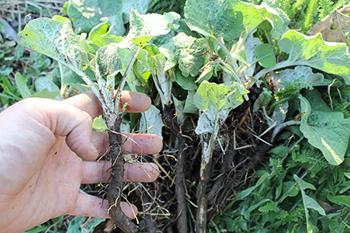
 Stems: Unless the flower stalks are young and tender, they are bitter and woody. The bitter outer layer must be removed before you cook it as a vegetable or in a dish such as soup or use it raw in salads.
- Stalks: These should be harvested when they are almost at their full height but have not formed buds or flowers yet. The outer layer must be peeled off.
- Leaves: Some people enjoy eating the leaves, but most find them unpleasantly bitter regardless of how they are cooked.
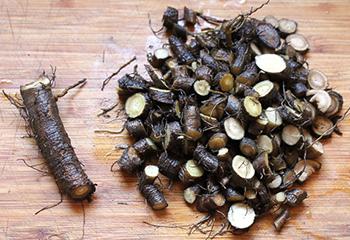
 Roots: These should be dug up in the autumn or spring in the first year of growth when the roots are still tender and juicy. They can be roasted, stir-fried, or grated and pickled after being washed thoroughly and cut up.
- For medicinal purposes, the roots must be washed, cut up, and dried very thoroughly to prevent mold from developing.
Be prepared to work hard to dig up the roots because of their depth. The best way to do so is to dig down parallel to the roots using a spade and then use a trowel to remove the soil around the roots. If you pull too hard too soon, the best roots or parts of the roots will remain behind.
Cooking with Burdock Root
Given how much of this article focuses on burdock as medicine, it’s easy to forget it’s a genuine vegetable with real culinary traditions behind it, particularly in Japan, where it’s known as gobo and treated as an everyday root vegetable rather than a remedy.
The classic preparation is kinpira gobo: burdock root sliced into thin matchsticks, soaked briefly in water to reduce bitterness, then stir-fried with a little oil until just tender and glazed with a simple mixture of soy sauce, mirin, and a touch of sugar. Carrot matchsticks are often added for color and a hint of sweetness, and the finished dish is usually topped with a scattering of sesame seeds.
It’s a genuinely good entry point if you’d rather get to know this plant through food before working with it medicinally, and it gives you a practical use for any root that’s a little too woody or mature for a delicate remedy.
What Burdock is Good For And The Natural Remedies Made From it
The plant’s constituent active ingredients are listed as being mucilage, fixed and volatile oils, sugar, inulin, crystalline glucoside, a bitter, and small amounts of tannic acid. The list of ailments and symptoms that Burdock has been and is used for is extensive. It is thought to:

 Be a diuretic
- Have antibacterial properties
- Reduce fever
- Act as a blood purifier
- Soothe gastrointestinal problems
- Reduce inflammation
- Lower blood pressure
- Regulate blood sugar
- Soothe dry, inflamed skin
- Treat acne
- Soothe sore throats and coughs
- Act as an antioxidant.
The limited number of studies that have been done don’t, unfortunately, look at each constituent found in the roots. However, it is believed that it is the tannins, plant sterols, and oils that Burdock contains that are beneficial.
It should be noted that much of the evidence in support of Burdock’s effectiveness is anecdotal. Further clinical research is required to satisfy some practitioners of the medicinal value of this plant.
What About Burdock and Cancer?
This comes up often enough to address directly, since it’s one of the more searched questions about this plant. A professionally reviewed clinical monograph describes laboratory and animal research into burdock’s root, leaves, seeds, and a compound called arctigenin against various human cancer cell lines, with proposed mechanisms including triggering cell death and interfering with cancer cell signaling. This is real, ongoing research, but it’s almost entirely limited to cells in a lab dish and animal models, not evidence that burdock treats cancer in people.
The one exception worth naming honestly is a small, early-phase human trial: a 2016 study gave a concentrated burdock fruit extract to 15 patients with advanced pancreatic cancer that had stopped responding to standard chemotherapy. The trial was designed to test tolerability and dosing, not effectiveness, and while one patient had a partial response and four had stable disease, this is far too small and preliminary a result to treat burdock as a cancer treatment.
If you’re dealing with a cancer diagnosis, the honest takeaway is that burdock is an active area of laboratory research, not a home remedy to rely on instead of medical care, and it should never be started without your oncologist’s knowledge given how it can interact with other treatments.
Burdock vs. Dandelion Root: What’s the Difference?
Burdock and dandelion root show up together constantly in herbal “blood purifier” and liver-support formulas, often blended into the same tea or tincture, which understandably leaves people wondering whether they’re interchangeable.
They’re not, even though their traditional uses overlap. Dandelion root leans more toward liver and digestive bitters, traditionally used to stimulate bile flow and support digestion, with a flavor that’s genuinely bitter throughout. Burdock root is milder and starchier, closer to a vegetable in both use and taste, with its traditional strengths centered more on skin conditions and its diuretic action.
Many herbalists use them together specifically because they complement rather than duplicate each other, dandelion working more on digestion and liver function, burdock working more on skin and elimination. If you’re only looking to address one specific concern, it’s worth researching which of the two is traditionally better suited to it rather than assuming either works as a general substitute for the other.
What Parts of The Plant are Used in Remedies?
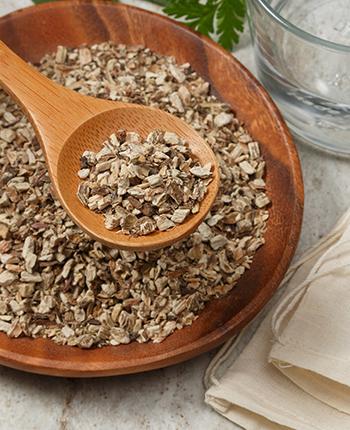
Traditionally, it is the root – usually from the first year of the plant’s growth – that is used in health and wellness preparations. However, the leaves and seed heads (also referred to as the fruit) are also utilized to a lesser degree.
- The root is utilized in a range of forms and preparations. It can form part of tea, tincture, or decoction, or be used in powdered form or to infuse the oil.
- Although leaves were historically used in poultices, they are now more frequently found in tinctures, teas, and decoctions.
- Similarly, the seeds are used in tinctures and to produce a potent oil.
What you are using Burdock for will determine which part of the plant is best for you and in what form it should be taken.
A DIY Burdock Recipe
One of the most useful and versatile forms in which to ingest Burdock is a tincture. The good news is that it’s helpful for a range of ailments and symptoms.
Ingredients and equipment:
- Burdock root
- Vodka (90 proof or more)
- A mason jar or some other jar that has an airtight lid
- A fine sieve and/or a piece of cooking muslin
Method
- Dig up several roots, wash them well, and chop them into large pieces OR buy chopped, the dried root from a reputable supplier.
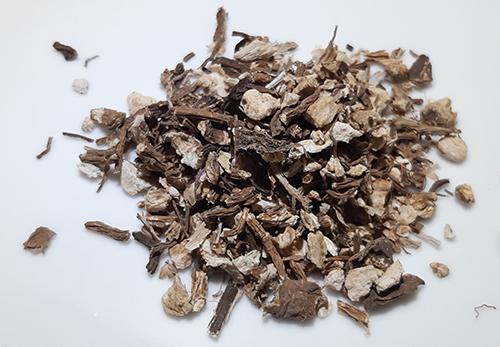
- Place the root into the jar until it is approximately 2/3 full
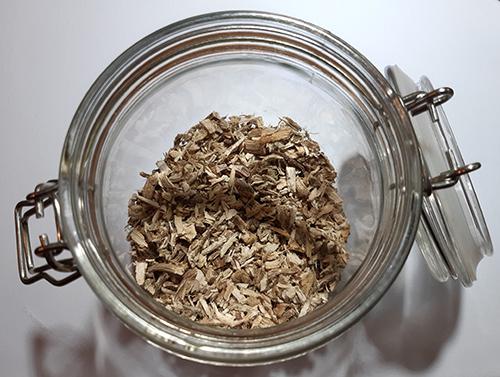
- Pour in the vodka until the mixture is approximately 1 inch / 2 ½ centimeters from the top of the jar
- Close the lid and label the jar so you know what’s in it and the date it was made
- Place the jar in a cool, dark place and shake it every week or so
- Leave it to infuse for 2 to 3 months
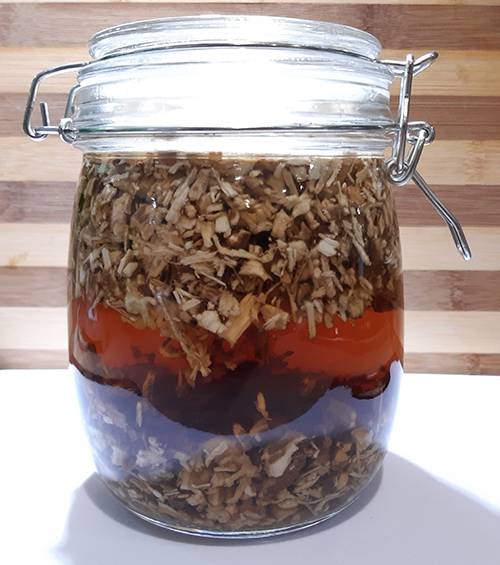
- Strain the liquid through a fine sieve or muslin or both to remove all the plant material
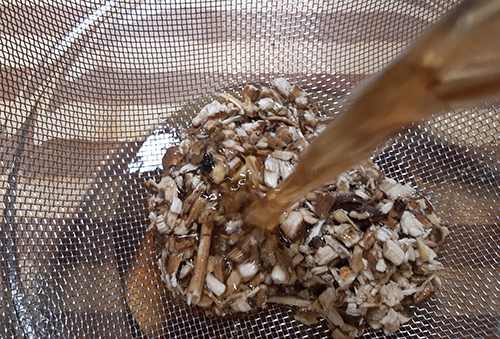
- Pour into and store the tincture in labeled dropper bottles.
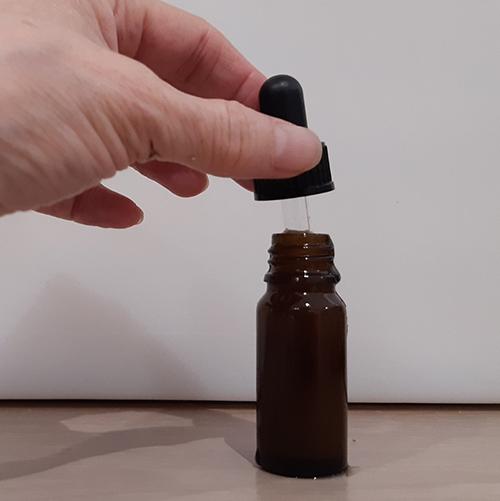
Tinctures, because they have an alcohol base which acts as a preservative, have an almost indefinite shelf life. However, they must be stored out of direct light.
Using Burdock Topically
Burdock’s traditional reputation for soothing dry, inflamed skin and acne mostly points to topical use, whether as an infused oil, a cooled strong tea used as a wash, or a leaf poultice. A little caution goes further here than people expect.
Patch test first. Apply a small amount of whatever preparation you’ve made to the inside of your forearm and wait 24 hours before using it anywhere else. Documented cases of allergic contact dermatitis from burdock exist, and this is an easy, low-cost way to catch a reaction before it’s on your face.
If you’re making an infused oil, follow the same gentle, low-heat infusion approach used for other herbal oils rather than applying fresh, undiluted plant material directly to broken or highly irritated skin. Discontinue use if you notice increased redness, itching, or irritation, since that can mean sensitization rather than improvement. As with any topical herbal preparation, treat continuous daily use for more than a few weeks as a reason to take a break and reassess rather than an indefinite routine.
Dosage
It’s not easy to give clinical dosage information because of the lack of studies. Generally, though, how much one uses is determined by a wide range of factors including:
- The user’s state of health
- The patient’s age
- The type of preparation being used
- What ailment being treated.
The specific figures below come from traditional 19th-century Eclectic medicine dosing, most notably King’s American Dispensatory (1898), not from modern clinical trials. They’re included as historical reference points rather than a substitute for professional guidance
There are various suggested doses:
- With Burdock tea, you can safely drink one cup a day
- A daily dose of 60 grains or 1/8 ounce of the ground root is indicated
- A decoction is safe at 3.7 milliliters up to three times a day
- An extract made from the seeds is taken as 10 – 30 drops daily.
Modern research offers a different kind of reference point, though a limited one. A clinical monograph reviewed by Drugs.com notes that a small trial on knee osteoarthritis used 6 grams per day of burdock root tea, while a separate phase I cancer trial established 12 grams per day of a concentrated burdock fruit extract as a tolerable dose in that specific, narrow context. Neither figure is a general recommended dose; both come from single studies with small numbers of participants, and the same source is explicit that there is limited clinical evidence to guide burdock dosing overall.
If you purchase a Burdock product, ensure that you (a) only do so from a reputable health outlet and (b) you follow the use and dose instructions on the packaging.
How to Preserve This Plant
As with so many plants that you want to use later rather than when they are still fresh, it is essential that all harvested Burdock material is thoroughly cleaned, dried, and stored. If not, you may have to throw it away because it has become moldy or started to decay.
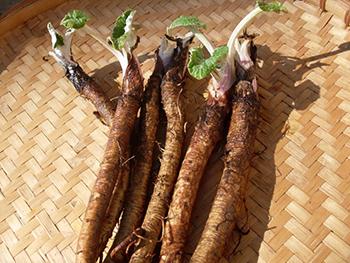
- Roots must be well washed to remove all the soil and other debris around them. Once they are clean, they can be cut into pieces or grated. Then, spread the root matter out on a suitable fabric or drying screen and place it in a warm, well-ventilated area. Move the material around every few days to ensure it all dries thoroughly. Once dried, store it in a labeled, airtight jar in a cool, dark place.
Related: How To Properly Dry Plants for Medicine
- Leaves that you wish to use in teas or other preparations must be spread out and dried in the same way the roots are. They dry faster, however, as they contain less moisture, to begin with.
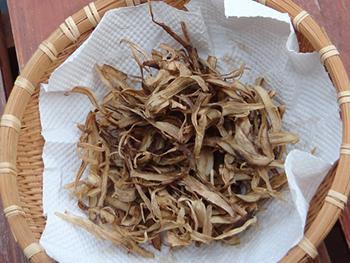
- Seeds should be removed from the flower head before being dried, preferably in the sun but otherwise in a warm, well-ventilated area.
If Burdock is properly processed and stored the root material will be usable for up to 12 months and the leaves for up to 6.
What Plants Resemble Burdock?
There are several plants that may be mistaken for this one. With most of them, the error will not cause any harm, but they won’t be as beneficial as Burdock. However, there are other misidentifications that could have serious – even fatal – consequences. It is therefore essential that you correctly identify the plant.
There is no confusing the plants when they are in bloom and/or producing fruit or seeds. The difficulty can be most acute when the plant is young. The easiest way to differentiate is, perhaps, by looking carefully at the leaves:

From left to right: Primrose, Dock, Rhubarb, Foxglove, Belladonna.
- Primrose: As with Burdock, the veins run to the edge and the leaves are not glossy. However, they are much smaller than Burdock leaves, a paler green, wavy, and have uneven edges and rounded tips.
- Dock: These leaves are narrower and glossier than Burdock leaves although they can also get large. They have a similar vein arrangement to Primrose and Burdock but are more pointed. There is no hair on the leaves.
- Rhubarb: These leaves get large. While they are also triangular or heart-shaped, they are much more uneven in shape than Burdock and they are hairless.
- Foxgloves: This plant is toxic. The leaves are more pointed than Burdock, and the mature ones are significantly smaller. They are pale green, matt leaves with fuzz on the underside of the leaves which makes them appear paler underneath. A significant feature is that the veins turn upwards and almost run parallel with the leaf’s main, central vein.
- Belladonna/nightshade: This plant is very toxic. The leaves are uneven in size, oval, pointed, untoothed / smooth-edged, glossy, and strongly ribbed. They are much more rounded and far smaller than Burdock leaves.
Warning And Cautions
As with any plant-based remedy or preparation, one shouldn’t assume it is 100% safe because it is 100% natural. Burdock is no exception and there are certain warnings and cautions that come with it:
- It’s best not to give Burdock to children
- Pregnant or breastfeeding women or those trying to conceive should avoid this herb
- Adhere to dosing recommendations or instructions as too much can be harmful
- People taking diuretics should not use this herb. Burdock has its own traditional diuretic action, and combining it with a diuretic medication can compound fluid and electrolyte loss beyond what’s intended.
- Those with an allergy to members of Asteraceae / Compositae plant family such as marigolds, daisies, or chrysanthemums may also be allergic to Burdock
- Patients with bleeding disorders or taking blood thinners should use caution, since burdock has been studied for activity against platelet-activating factor, a mechanism involved in blood clotting, and its effect alongside blood-thinning medication has not been well established.
- Diabetic individuals should avoid Burdock, particularly alongside blood sugar medication. The same Drugs.com monograph lists this directly: burdock may enhance the hypoglycemic effect of medications already used to lower blood sugar, raising the risk of blood sugar dropping too low.
- You should stop using this herb two weeks before a scheduled surgery
If you are harvesting or foraging in the wild, ensure that you have correctly identified Arctium lappa or and Arctium minus as there are similar plants that look similar and are potentially fatal if ingested.
Frequently Asked Questions
Is burdock the same thing as gobo?
Yes. Gobo is simply the Japanese name for the same plant, Arctium lappa, prepared and eaten as a vegetable rather than used medicinally. It’s the same root discussed throughout this article.
Can you eat burdock root raw?
It’s technically possible, but raw burdock root is tough, fibrous, and much more bitter than the cooked version. Nearly every culinary tradition that uses it cooks it first, whether by roasting, stir-frying, or simmering, which is also true for most other root vegetables in this same texture category.
Is it safe to take burdock every day?
This isn’t well established either way. Available research doesn’t provide enough evidence to confidently recommend long-term daily use, so many herbalists suggest treating it the way you would any other herbal remedy: used with intention for a specific concern, with periodic breaks, rather than as an indefinite daily supplement.
What does burdock root actually taste like?
Mildly sweet at first, with a bitterness that builds the longer you chew, and a slightly mucilaginous texture similar to a cross between a parsnip and an artichoke heart. Cooking mellows the bitterness considerably, which is part of why it’s more popular as a cooked vegetable than a raw one.
You may also like:
 8 Medicinal Herbs You Should Be Picking This Summer
New Invention 12X More Efficient Than Solar Panels (Video)
How To Make An Anti Inflammatory Herbal Jar (Pickled Purslane)
How to Tell the Difference Between Bittersweet Nightshade and Deadly Nightshade

I was a victim of gout for a number of years but, I found out that ‘burdock’ was a herbal remedy for gout. In December of 2011 I began taking burdock capsules. (2/day then) and have not had a gout attack since. (1/day now). I am a firm believer in the ‘power of burdock’
Hi Mike,
Thank you so much for sharing your experience with us.
I’m glad to hear that The Power of burdock worked for you.
God bless!
Interesting & Informative
Why does it not grow in the southern US but it grows in hotter places like India?