
Why Big Pharma Originally Derived These 7 Common Drugs From Plants
Open your medicine cabinet and you may be looking at something that began, in one form or another, with a plant.
That headache tablet. A powerful heart medication. One of the most important diabetes drugs ever developed. Even medicines used against malaria and cancer.
Long before scientists could manufacture precise pharmaceutical compounds, plants were already producing remarkably complex chemistry of their own.
And people noticed.
For thousands of years, healers experimented with bark, roots, leaves and flowers. Sometimes those traditional uses led nowhere. But other times, researchers found something extraordinary hiding inside the plant: a compound that could be isolated, studied, refined and eventually turned into a modern medicine.
That does not mean swallowing a handful of leaves is the same as taking a carefully dosed pharmaceutical. In some of the examples below, the original plant can actually be dangerous.
But if you’ve ever wondered whether herbal medicine really influenced the pills sitting behind today’s pharmacy counter, these seven stories are hard to ignore.
1. Willow Bark → Aspirin
If you’ve ever taken aspirin for pain, fever, or inflammation, its family tree leads back to the willow.
The Sumerians reportedly used willow-based remedies for pain relief as early as 4000 years ago.
Hippocrates used willow bark for managing pain and fever. He also used tea brewed from willow bark to manage pain during childbirth.
People were using willow preparations for discomfort thousands of years ago. The bark contains salicin, which your body can ultimately convert into salicylic acid.
During the 1800s, researchers learned to isolate and work with these salicylates. Eventually, chemists developed acetylsalicylic acid, the medicine we now know as aspirin.
Today, aspirin does much more than relieve an occasional headache. Because it affects platelet activity, doctors also use it in specific cardiovascular situations to help reduce blood clot formation.
You also want to learn about: Persimmon
There’s an important distinction here: aspirin is not simply powdered willow bark pressed into a tablet. It is a modified, standardized compound with predictable dosing.
And predictable dosing matters.
Aspirin can irritate the stomach and increase bleeding risk, while children and teenagers with certain viral illnesses generally should not receive aspirin because of the association with Reye syndrome.
Still, the next time you see a willow tree, remember: you’re looking at a plant whose chemistry helped shape one of the most recognizable medicines on Earth.
Willow is one of those plants that proves our ancestors were paying attention.
But knowing willow bark contains salicin is not the same as knowing how to prepare it properly, how much to use, or when to avoid it.
If you want to learn how to prepare willow bark straight from a herbalist, Nicole Apelian, Ph.D., shows the full traditional preparation in her bestseller with the exact steps, measurements, and instructions laid out clearly.
I’ll place the recipe image here: 
Click here to see the full willow remedy recipe.
2. French Lilac → Metformin
This one surprises a lot of people.
Galega officinalis, sometimes called French lilac or goat’s rue, has a long history in European herbalism. Researchers eventually became interested in compounds related to guanidine, which showed an ability to lower blood glucose.
The early compounds weren’t ideal. Some were simply too toxic.
But scientists kept working with the chemistry.
Related: This is How They’re Poisoning Us Everyday
That pathway eventually helped lead to metformin, a biguanide medication that became one of the most widely used treatments for type 2 diabetes.
Metformin helps lower blood glucose largely by reducing the amount of glucose produced by the liver and improving the body’s response to insulin.
This is a perfect example of why plant medicine and pharmaceutical medicine shouldn’t always be viewed as enemies.
Related: People Weed Out These Plants, But Here’s What You Should Do Instead
The plant provided a clue.
Science followed that clue, altered the chemistry, worked on safety and dosing, and developed a drug that millions of people now use.
That does not make French lilac a DIY replacement for metformin. The raw herb contains compounds that do not behave exactly like the finished medication, and metformin itself still requires appropriate medical use, particularly because of the rare but serious risk of lactic acidosis.
French lilac helped point science toward one of the most important blood-sugar medicines ever made.
But that does not mean you should experiment with the raw plant at home.
If blood sugar, heart health, and metabolic balance are concerns for you, you might want to look towards a broader herbal-support routine. That means not just one herbal tincture, but more.
And how can you feed your body with powerful preparations without spending a fortune? Our favorite herbalist, Nicole, created a Heart, Blood Pressure & Blood Sugar Bundle to make it convenient for every household.
It brings together tinctures like cordyceps, reishi, turkey tail, lemon balm, and her special Heart Health Blend, made to support the body from several angles instead of relying on one random herb.
Check out more about the bundle here.
3. Foxglove → Digoxin
Foxglove may be beautiful, but this is one plant you should admire rather than casually experiment with.
Species of Digitalis contain cardiac glycosides, powerful compounds that affect how the heart beats.
Centuries ago, physicians began using foxglove preparations for “dropsy,” an old term often associated with fluid retention from heart failure.
Eventually, one of its important compounds became the drug digoxin.
Digoxin can increase the force of heart contractions and influence electrical conduction through the heart. Doctors still use it in selected cases of heart failure and certain abnormal heart rhythms.
But here’s where plant potency becomes impossible to romanticize.
Also Read: The Nerve Soothing Remedy You Need on Hand
Caution: Foxglove can be poisonous. Digoxin itself has what doctors call a narrow therapeutic window, meaning the difference between a helpful amount and a harmful amount can be relatively small.
Too much can cause nausea, weakness, and dangerous heart rhythm abnormalities.
Sometimes a medicinal plant teaches you not only how powerful nature can be, but why precise dosing matters.
Foxglove is the kind of plant that reminds you how powerful nature can be.
But your heart is not something to experiment with.
It beats roughly 100,000 times a day. If you’re over 50, it has already worked billions of times for you. That deserves steady, thoughtful support.
If the bundle I mentioned above is not right for you, I’ve got your back! You can still get plenty of benefits from Nicole’s Heart Health Blend, which combines these well-known plants: hawthorn, tulsi, fenugreek, and bilberry, in one ready-made tincture for everyday cardiovascular and metabolic support.
Try out this powerful combination here.
4. Opium Poppy → Morphine and Codeine
For severe pain, very few natural compounds have influenced medicine as dramatically as those found in the opium poppy, Papaver somniferum.
Its latex naturally contains several alkaloids, including morphine and codeine.
Morphine was isolated in the early 1800s and became one of medicine’s defining pain-relieving drugs. Codeine also became widely used for pain and, in some situations, cough suppression.
These compounds act on opioid receptors in the central nervous system, changing the way pain signals are perceived.
Their effectiveness comes with a serious downside.
Opioids can cause sedation, dependence, addiction, and potentially fatal respiratory depression when misused or taken in excessive amounts.
So this isn’t a case where “natural” automatically means gentle.
Quite the opposite.
The opium poppy is one of the clearest reminders that plants can produce chemicals every bit as powerful as those associated with a pharmaceutical laboratory.
The opium poppy is in a category of its own.
But it’s not the only poppy with a long traditional connection to rest and relaxation.
California poppy is different. It’s gentler, non-opioid, and commonly used by herbalists in sleep-support preparations.
Herbalists traditionally prepare California poppy in teas, tinctures, infusions, and other home preparations.
And the best part?
You can grow it yourself.
When you start from seed, you control the plant from the very beginning. The soil. The water. The harvest. The remedy. There is nothing earlier than that.
You can plant it outdoors while the weather still helps, or grow it in pots indoors when the cold starts coming.
Imagine yourself watering the soon-to-be remedies of your home. This connects you to nature more than anything can. I kindly recommend Nicole’s kit, which includes California poppy seeds plus 9 other medicinal plants you can grow at home.
5. Cinchona Bark → Quinine
Imagine living in a world where malaria could strike and doctors had almost nothing reliable to stop it.
Then came the bark of the cinchona tree.
Cinchona species, native to South America, contain several alkaloids — most famously quinine.
Cinchona bark made its way into European medicine centuries ago as a treatment for fevers associated with malaria. By the early 1800s, scientists had isolated quinine.
For generations, it became one of the most important antimalarial medicines available.
Quinine is still medically useful in certain situations today, although newer antimalarial drugs are often preferred.
And once again, the original plant chemistry comes with limitations.
Excess quinine can produce a group of symptoms known as cinchonism, which may include ringing in the ears, headache, dizziness, nausea and visual disturbances.
The word cinchonism comes from the Cinchona tree, which is the source of quinine. The people of Peru used the bark of the Cinchona to prevent shivering by mixing ground bark with sweetened water, producing a tonic solution. The Jesuits primarily brought Cinchona to Europe, using it to manage malaria in Rome, which was the first effective therapy available against Plasmodium falciparum when other drugs, such as chloroquine, emerged.
The lesson keeps repeating itself: nature can supply the molecule, but dose and preparation can completely change the outcome.
6. Sweet Wormwood → Artemisinin
Few plant-drug stories are as remarkable as Artemisia annua, also known as sweet wormwood or qinghao.
The plant had been recorded in traditional Chinese medicine for centuries.
In the 20th century, researcher Tu Youyou and her team investigated traditional preparations of the herb while searching for new malaria treatments.
That work led to the isolation of artemisinin.
Artemisinin and its derivatives became extraordinarily important antimalarial drugs, particularly against Plasmodium falciparum. Tu Youyou later shared the 2015 Nobel Prize in Physiology or Medicine for the discovery.
Today, artemisinin-based medicines are generally used in combination therapies, which helps improve treatment effectiveness and slow the development of parasite resistance.
That last point matters.
Drinking random amounts of sweet wormwood tea is not the same thing as receiving a standardized artemisinin-based treatment.
But the discovery itself remains remarkable: knowledge surrounding an old medicinal plant helped lead researchers toward one of modern medicine’s most valuable weapons against malaria.
Sweet wormwood helped change the history of malaria medicine.
But this is another reminder that preparation matters.
The wrong amount, the wrong method, or the wrong plant can turn a useful tradition into a risky guessing game.
For me, following a step-by-step manual of making remedies is the only way I trust myself. Otherwise, I’m never completely sure I’ve prepared it correctly or safely.
So if you want the instructions for the parasite recipe below, check it out here. I’ll leave you a picture I took of the digestive parasite-support recipe. 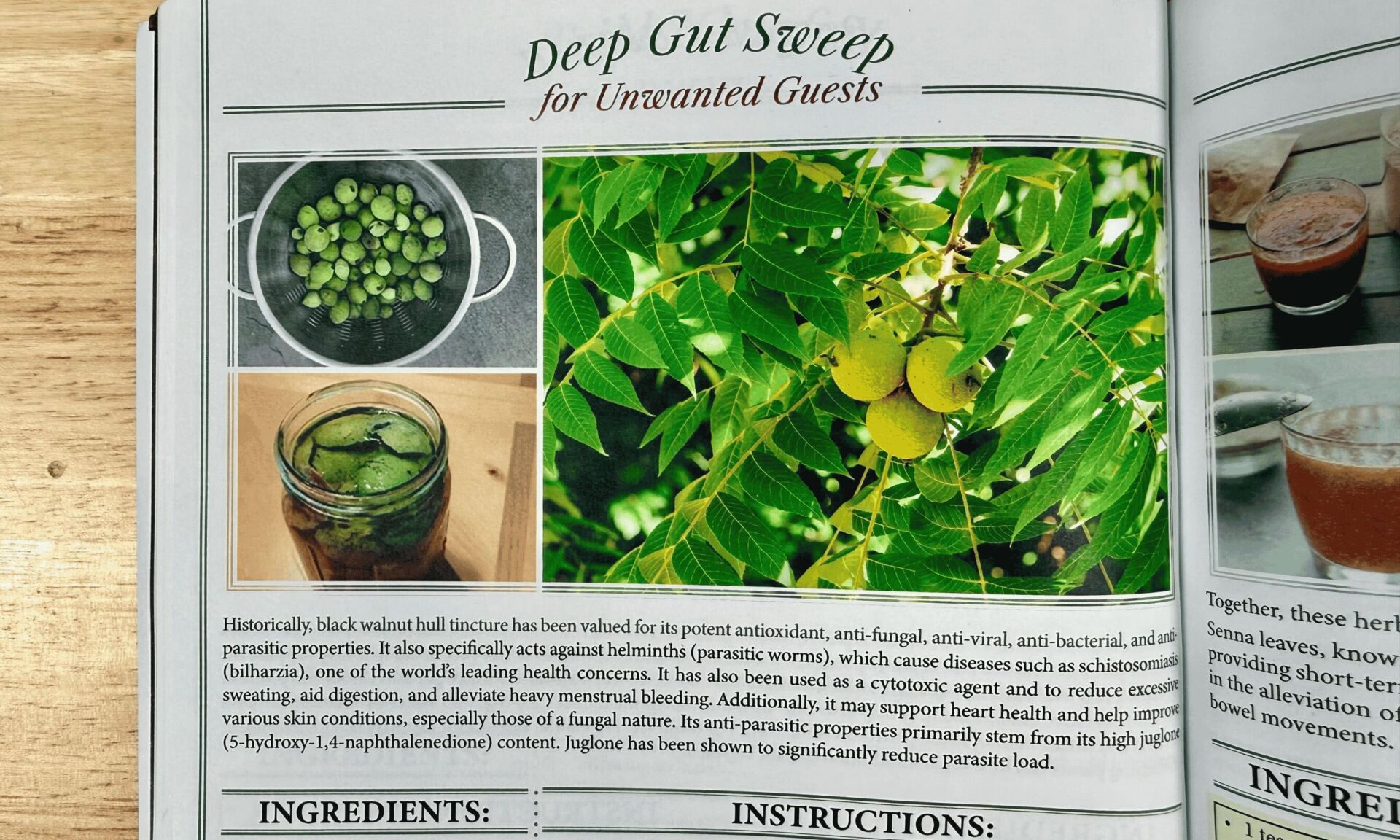
When it comes to your health, having clear steps, measurements, and pictures means you’re not piecing it together from random advice online. Then you wonder why it doesn’t work.
And once you start thinking about parasites, digestion, and gut balance, you realize something important:
Your gut needs support even when you’re not doing a cleanse.
Just so you don’t have to read another article, I’ll leave here some very strong gut-supporting herbs and mushrooms to keep in mind: marshmallow, slippery elm, plantain, reishi, turkey tail, and lion’s mane.
Though it may sound complicated to get all of these, I saved myself the trouble with Nicole’s gut-supporting tincture that combines all of the above. It’s really the easiest option. And it’s one of her most popular tinctures, so clearly I’m not the only one who likes the convenience.
Check out how it’s made and what people say about it, right here.
7. Pacific Yew → Paclitaxel
Finally, there is the Pacific yew.
In the 1960s, researchers working through a National Cancer Institute plant-screening program investigated samples from Taxus brevifolia, the Pacific yew tree.
They discovered a compound that showed powerful activity against dividing cells.
That compound became paclitaxel, originally known by the brand name Taxol.
Paclitaxel works by interfering with the microtubules cells need during division. Because cancer cells divide rapidly, this made the compound enormously important in oncology.
Today, paclitaxel is used in the treatment of several cancers, including breast and ovarian cancers.
It is also a perfect example of why “plant-based” does not mean mild.
Paclitaxel is chemotherapy. It can cause significant adverse effects, including suppression of blood cells and peripheral neuropathy, and it must be given under medical supervision.
Yet its origin remains astonishing.
A tree growing quietly in the forests of the Pacific Northwest helped provide the starting material for one of modern oncology’s landmark medicines.
When the article turns toward the “Big C,” turkey tail is worth mentioning.
Not as a replacement for treatment. Never.
But purified turkey tail preparations have been used alongside conventional cancer care in Japan, which says something important: mushrooms are not just folklore. Some of them are serious enough to be studied in very serious settings.
For everyday immune support, a turkey tail tincture can be one simple way to bring that mushroom into your routine.
Check out the turkey tail tincture I recommend here.
What These 7 Plants Really Tell Us
You don’t have to choose between respecting traditional herbal knowledge and respecting modern medicine.
History shows that the two have crossed paths again and again.
Willow helped point toward aspirin. Foxglove gave us cardiac glycosides. Sweet wormwood opened the door to artemisinin. The Pacific yew yielded paclitaxel.
Plants aren’t primitive chemistry.
They are chemistry.
And understanding that makes herbalism even more fascinating, not because every herb should replace a prescription, but because the natural world has repeatedly given science molecules worth studying.
So the next time you walk past a willow, notice foxglove in a garden, or read the name of an herb you’ve known for years, remember this:
Sometimes the distance between an old herbal remedy and a modern medicine is much shorter than you think.
These seven plants show something powerful:
Modern medicine and old plant knowledge have crossed paths again and again.
But knowing a plant’s story is not the same as knowing how to use it safely.
If you’re into remedy-making and learning about plants like nobody in your neighbourhood, I’ll tell you the best knowledge source.
Nicole Apelian herself teaches you how to identify medicinal plants, avoid dangerous lookalikes, and turn them into salves, poultices, tinctures, syrups, extractions, elixirs, and other traditional preparations.
You don’t just read about the remedies. You watch how they are made. 
And when a plant can be helpful in one form but dangerous in another, that skill matters.
Join The Lost Remedies Academy here and learn the remedies from a real herbalist.
You may also like:
The ‘Nerve Oil’ You Should Use For Shaky Hands
Never Do This Before Going To Sleep (Video)
The Mushroom That Can Regrow Brain Tissue
🌿 Join Our Private Herbal Community For Free. 👉 Click here!
References
NCBI Bookshelf — Salicylic Acid (Aspirin) – https://www.ncbi.nlm.nih.gov/books/NBK519032/
U.S. Preventive Services Task Force — Aspirin Use to Prevent Cardiovascular Disease – https://www.uspreventiveservicestaskforce.org/uspstf/recommendation/aspirin-to-prevent-cardiovascular-disease-preventive-medication
NCBI Bookshelf — Metformin – https://www.ncbi.nlm.nih.gov/books/NBK518983/
Research!America — Highly Prescribed Diabetes Treatment Stemmed from a Flowering Plant – https://www.researchamerica.org/blog/did-you-know-highly-prescribed-diabetes-treatment-flowering-plant/
NCBI Bookshelf — Digoxin – https://www.ncbi.nlm.nih.gov/books/NBK556025/
NCBI Bookshelf — Morphine – https://www.ncbi.nlm.nih.gov/books/NBK548230/
NCBI Bookshelf — Cinchonism – https://www.ncbi.nlm.nih.gov/books/NBK559319/
National Cancer Institute — Discovery: Natural Compound Offers Hope — Paclitaxel (Taxol) – https://www.cancer.gov/research/progress/discovery/taxol
NCBI Bookshelf — Paclitaxel – https://www.ncbi.nlm.nih.gov/books/NBK536917/
The Nobel Prize — The 2015 Nobel Prize in Physiology or Medicine – https://www.nobelprize.org/prizes/medicine/2015/summary/
NCBI Bookshelf Artemisinins – https://pmc.ncbi.nlm.nih.gov/articles/PMC2758403/