
These Lost Herbal Skills Once Made Us Independent
Are you tired of looking for solutions your way and never quite finding what you need?
The kind of practical solutions that help you become independent instead of always needing something already made for you?
Maybe you vaguely remember a traditional recipe someone in your family used to make. You remember the herb. Maybe one or two ingredients. But not enough to actually recreate it.
And when you finally search for it, you find ten modern versions, but not the one you remember.
It seems some recipes and household skills simply disappeared somewhere between our grandparents’ kitchens and the internet.
But let me show you something.
I recently found a collection of herbal remedies, old food-preservation methods, gardening skills, and practical household knowledge that is becoming almost impossible to find anywhere else in this form.
And as I went through it, I kept thinking the same thing:
Why Don’t They Make Books Like This Anymore?
I found this book that has an entire section called Lost Healing Remedies, and this was naturally the first place I went.
Some of the remedy names immediately caught my attention. Just take a look at this:
That should give you a much better feel for the kind of old-fashioned preparations this book actually includes.
And here is what I liked about the way the book handles them.
It does not bury you in pages of theory before you get to the useful part.
You see what you need. You see the steps. You see how the preparation comes together.
That matters because knowing that a plant has a traditional use is one thing.
Knowing how to turn it into something you can actually make is another.
A lot of us have collected plenty of herbal information over the years. You probably have saved articles, bookmarked videos, screenshots, books, and maybe even notebooks full of remedies.
But when you actually want to make something, you still have to hunt down the exact quantities and steps.
Worse, many books keep circling around the same remedies you have already seen dozens of times.
This book surprised me because it goes beyond that familiar material.
You find unusual herbal preparations beside old preservation methods, practical plant uses, growing skills, and household techniques that rarely appear together in one book.
And instead of simply telling you what people used to do, it shows you how to do it yourself.
One of the Simplest Preparations Is Also One of My Favorites
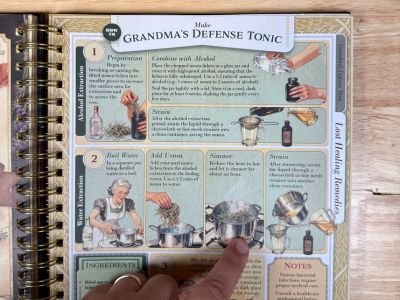
This is the kind of preparation I mean when I say the book goes beyond the herbal recipes you keep seeing repeated everywhere.
It feels much closer to something you might have found handwritten in an old family notebook than another basic tea or syrup.
And the useful part is that you get the ingredients, quantities, and illustrated steps, so you can actually see how the preparation comes together.
That is what I kept noticing throughout the remedy section.
It gives you more things you can actually learn to make yourself.
The physical format helps too. The book is hardcover and spiral-bound, so you can lay it flat on the counter while you mix a remedy or follow a recipe without constantly fighting to keep the pages open.
It feels much more like a practical working manual than a book you simply read and put back on the shelf.
You Can Even Learn How to Make Oil From Plants
This was one of the pages I did not expect to find.
 The book shows you how to make oil from plants such as lavender, mint, or lemongrass using a steam-distillation setup.
It takes you through the process from fresh plant material to separating the aromatic oil from the hydrosol.
If you use essential oils, you have probably bought plenty of little bottles over the years.
But have you ever actually seen the entire process from plant to bottle?
That is one of the recurring ideas in this book.
Instead of only showing you what to buy or use, it shows you how some of those things are made.
And once you notice that, you start seeing the same idea in the gardening, food, water, and household sections too.
A Remedy Becomes More Useful When You Can Grow the Plant
This is another thing I thought the book got right.
It does not give you a section full of herbal preparations and then leave you completely dependent on buying every ingredient.
There is also a full Self-Sustaining Garden section, including a project for making an Emergency Herbal Garden.
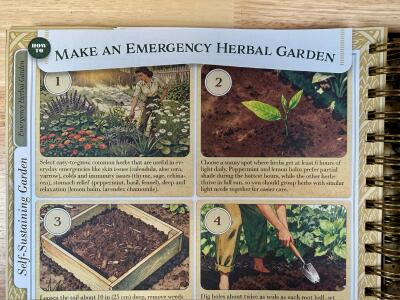 You’ll also find companion planting, container gardening, regenerative gardening, composting, homemade fertilizer, organic insect control, greenhouses, vertical gardens, and ways to grow more food in smaller spaces.
So in some cases, the book does not only show you what to make with a plant.
It also shows you how to make sure you have the plant in the first place.
If you already grow herbs, you know how satisfying that is.
You walk outside, harvest what you need, and use something you grew yourself instead of ordering another bag, bottle, or packet.
You do not need acres of land to start either.
A few containers or a small dedicated bed can already give you a useful supply of plants you regularly use.
The Pantry Was Part of the Home Apothecary
Older households did not always draw a hard line between food and remedy. It was the same remedy cabinet.
Take bone broth. People have made it for generations, and today we know collagen is an important structural protein in connective tissues such as skin, cartilage, tendons, and bone. Slow cooking breaks collagen-rich connective tissue down into gelatin and amino acids your body can use as part of normal protein metabolism.
The book shows you how to make collagen-rich bone broth yourself, alongside many other preparations you can actually keep around the house.
It can also include things you can make and keep on hand: fermented garlic and honey, elderberry syrup, fire cider, herbal drops, mushroom extracts, soothing salves, bone broth, and other traditional preparations that sit naturally between food and herbal practice.
What Would You Actually Keep in a Traditional Remedy Pantry?
This is where I think the book becomes especially useful for herbal readers.
You could have bone broth for a nourishing traditional food, honey-fermented garlic and fire cider for cold-season traditions, elderberry syrup and mushroom extract among your herbal preparations, plus things like Stop-Bleeding Powder, Black Drawing Salve, and Breathe Easy Elixir ready to reference when you want to make them yourself.
Instead of scattering all of that knowledge across articles, videos, and old notes, the book brings these kinds of preparations together in one practical place.
What I Like Most Is How Everything Connects
There are 200 illustrated skills in the full book, covering everything from gardening and food preservation to water and household projects. But honestly, the herbal section was enough to keep me interested on its own.
You can buy a herbal book that focuses entirely on plants.
You can buy a gardening book.
You can buy a food-preservation book.
You can buy a survival manual.
What makes this one different is that it puts those skills beside one another.
It gives you a much broader picture of what independence used to mean.
You do not need to do everything yourself.
You just know how to do more for yourself.
You do not need a blackout to benefit from knowing how to preserve food.
You do not need pharmacies to disappear before growing medicinal herbs becomes useful.
You do not need an emergency to appreciate knowing how to collect rainwater, make compost, grow vegetables, or turn a plant into something useful.
Most of these skills simply give you another option.
You Probably Won’t Use All 200 Skills
You probably won’t use every one of the 200 skills in this book.
But for me, that was never the main value anyway.
What makes it interesting is the remedy knowledge buried inside it.
These are not just the same five herbal recipes you keep seeing repeated online. The book brings together old household preparations, Amish-inspired remedies, tinctures, syrups, salves, extracts, and other traditional formulas that are becoming surprisingly difficult to find presented this way.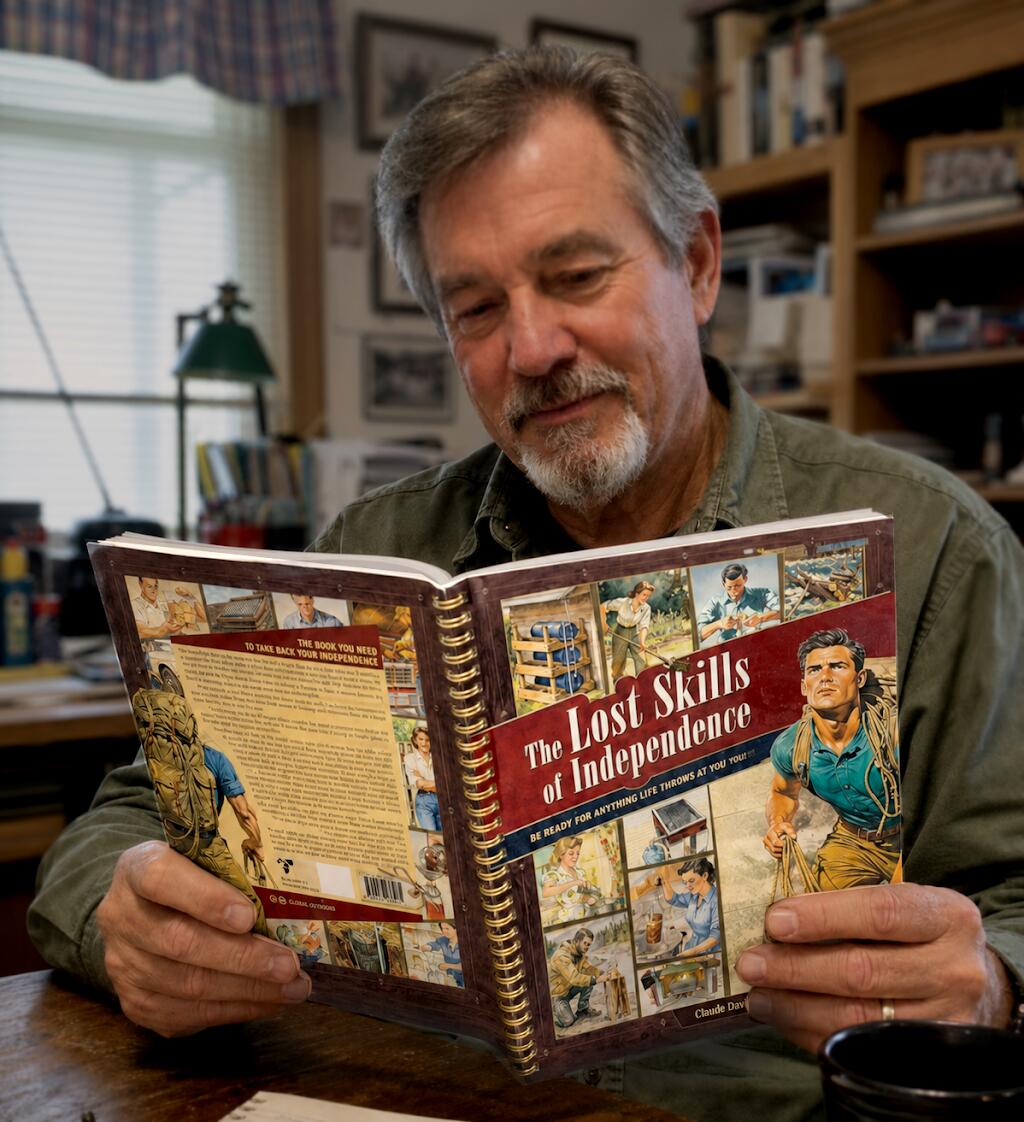
The book itself describes its natural-remedy material as drawing on traditional, folkloric, and historical uses.
And if you came here for the medicinal side, there is enough unusual herbal material here to keep you flipping through the book for a long time.
And you do not have to remember where you saved the information online.
You already have it in front of you.
You Also Get Three Extra Guides
The physical book currently comes with three additional guides.
The first is called Wild Edibles & Medicinal Herbs You Can Forage Around Your House.
That one expands the plant side of the main book and focuses on useful edible and medicinal plants you may already have growing nearby.
The second is How to Become Self-Sufficient on a 1/4 Acre of Land.
And the third is The Patriot’s Bug-In Guide, which focuses more heavily on keeping your home supplied and functional during difficult situations.
Would I Get It for the Herbal Skills?
That is what originally made me curious about it.
And yes, the herbal section is still probably my favorite part.
But after going through the rest of the book, I think it works better as a whole than it would as another collection of remedies.
Because herbal independence is not only knowing how to make a tincture.
You also benefit from knowing how to grow useful plants, preserve what you harvest, keep food longer, make simple preparations yourself, and solve a few more everyday problems without immediately buying the finished solution.
That is really what the book is collecting: 200 practical things you can learn how to do.
And there is an important difference between owning a product and owning a skill.
A bottle eventually empties.
A packet gets used.
A bookmarked video can disappear.
Once you actually learn how to do something, you can use that knowledge again.
If that sounds like the kind of information you would rather keep in one physical book than scattered across hundreds of websites, videos, screenshots, and saved posts, you can take a closer look at The Lost Skills of Independence here.
The current edition is also being offered with the three bonus guides and a 60-day money-back guarantee.
So you have time to go through it yourself, try some of the skills that interest you, and decide whether this is the kind of knowledge you want to keep around.
I originally opened it for the remedies.
I ended up bookmarking quite a few other pages too.
You may also like: 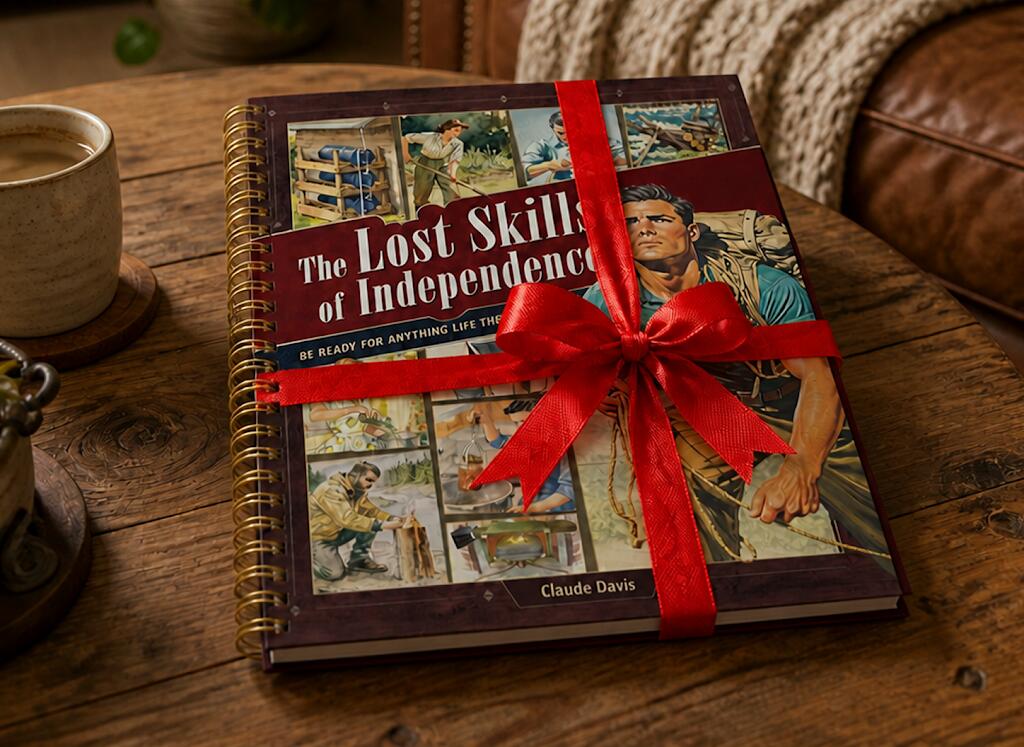
Our Facebook Group Is Temporarily Accepting New Members!
Natural Zepbound Recipe – Herbs and Foods That Support the Same Pathways
How to Dry Herbs – A Complete Beginner’s Guide
How to Make Iced Matcha (The Right Way)
finally
Thank you!! Ordered!