

Herbal Salve Body Map
You don’t always need a complicated routine when your body starts asking for a little extra care.
Sometimes it’s the bruise on your shin that seems to appear out of nowhere. Sometimes it’s the stiff knee you notice every time you stand up. Or the mosquito bite you cannot stop scratching. Or the cracked heel that catches on your bedsheets at night.
That’s why I’m writing this article and recommending that you create a well-stocked herbal cabinet.
For generations, people have turned plants into thick oils, balms, and salves that stay on the skin long enough to deliver their soothing compounds exactly where they are needed.
Arnica for a bruised leg. Calendula for irritated skin. Peppermint across tense temples. Tea tree around a troublesome toenail.
Different part of the body. Different plant.
Think of this as your herbal salve body map, a simple guide to the herbs worth knowing from head to toe, what they may help with, and where you need to be a little more careful.
And there’s one more reason to keep reading. Later in this article, I’m going to share something completely new, something we’ve never presented before on The Lost Herbs.
If you enjoy making your own herbal remedies, you’ll definitely want to see this one. Stay with me; you won’t regret it.
6. Salve for Stiff Joints & Tired Muscles: Arnica + Cayenne
There is a particular kind of stiffness you notice immediately.
You stand up after sitting too long, and your knees protest. Your shoulders feel heavy after gardening. Your hands remind you of every repetitive task you did that day.
This is where a warming herbal salve can feel especially comforting.
Arnica is one of the best-known herbs for topical use on sore muscles, bruised areas, and stiff joints. Cayenne brings something completely different to the blend: capsaicin, the compound that gives chili peppers their heat and creates that familiar warming sensation on the skin.
Together, they make a strong foundation for a joint and muscle rub.
Related: Why You Should Put Usnea in Your Socks
You can build on that with herbs traditionally used in topical preparations, including calendula, St. John’s wort, cottonwood buds, frankincense, or helichrysum.
A homemade joint salve might contain:

- Arnica-infused oil
- Cayenne
- Calendula
- St. John’s wort
- Cottonwood buds
- Olive oil
- Beeswax
Massage a small amount into stiff knees, hands, shoulders, or tired muscles when you want that warming, soothing feeling.
This kind of salve is especially useful after a long day on your feet, gardening, hiking, repetitive work, or any activity that leaves your muscles feeling overused.
Just remember that cayenne can sting. Keep warming salves away from the eyes, mouth, nose, other sensitive areas, and broken skin. Wash your hands thoroughly after applying.
To me, cayenne proves how powerful plants can be.
You feel that warmth within seconds.
But that is also why I stopped making my own cayenne salve. Handling hot peppers, infusing them, straining the oil, and then trying not to touch your eyes afterward is not exactly fun.
So now I use the ready-made version: a warming cayenne salve boosted with arnica, calendula, St. John’s wort, cottonwood buds, frankincense, and helichrysum for more complete topical support.
It’s the kind of thing you rub on when your knees, hands, shoulders, or back remind you they exist.
Skip the cayenne mess and get the finished salve here.
5. Salve for Your Temples: Peppermint + Lavender
Some days, you don’t need another cup of coffee.
You need ten quiet minutes.
A cool room.
And something soothing rubbed across your temples.
This is one of my favorite places for aromatic herbs.
Peppermint contains menthol, which creates that familiar cooling sensation. Topical peppermint preparations have also been investigated for tension-type headaches, with encouraging results.
Then there is lavender, one of the classic herbs associated with relaxation.
I felt this the most when I tried making my own little lavender relaxation pouches.
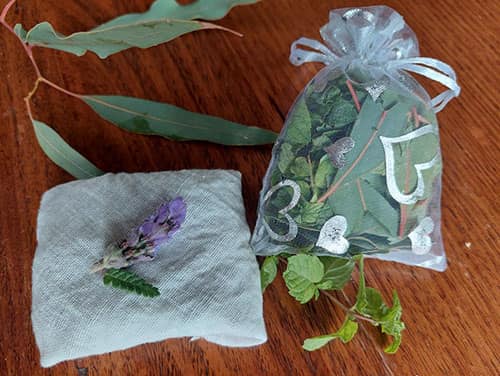 You basically tuck dried lavender into small sachets (just as you can see in the image) and keep them near your pillow, in a drawer, or beside the bed. That soft scent makes the whole evening feel calmer. Click the image for detailed instructions.
Pair that with some lemon balm benefits, and you have a simple night ritual that feels like something your grandmother would have done.
Peppermint and Lavender make an easy aromatic balm to keep beside your bed, in your purse, or next to your desk.
Try:
- Jojoba or sweet almond oil
- Beeswax
- Properly diluted peppermint essential oil
- Properly diluted lavender essential oil
- Optional chamomile (I grew my own chamomile using these medicinal seeds.)
Use just a tiny amount.
Rub it gently into your temples or the back of your neck, then give yourself a minute to actually stop what you are doing and breathe.
That ritual matters too.
Just keep essential oils away from the eyes and mucous membranes. More is not better here, the aroma should be pleasant, not overpowering.
4. Salve for Toenails: Tea Tree
Toenails are easy to ignore.
Until one becomes thick, yellow, brittle, or starts crumbling around the edges.
Fungal nail problems can be especially stubborn because the infection may sit beneath the hard nail plate, where topical ingredients struggle to reach.
Still, tea tree oil has attracted considerable interest because of its antifungal activity.
An older clinical study found tea tree oil performed similarly to clotrimazole in participants with toenail fungus, although nail fungus remains notoriously difficult to manage and evidence for herbal treatments is still limited.
A simple toenail balm could include:
- Diluted tea tree essential oil
- Coconut or almond oil
- Beeswax
- Optional thyme or oregano essential oil at very low concentrations
Apply a small amount around the nail and surrounding skin consistently.
But do not expect an overnight transformation.
Toenails grow painfully slowly. Even successful treatment can take months before healthy-looking nail replaces the damaged portion.
And if the nail continues thickening, becomes painful, spreads to other nails, or you have diabetes or circulation problems, get it properly evaluated.
Tea tree oil should also never be swallowed.
You can make this kind of toenail balm even stronger by combining tea tree with herbs like thyme, garlic, oregano, marjoram, and lavender.
Before you wonder why anyone would go that far, these plants have long been valued in traditional preparations for stubborn fungal skin and nail problems.
And toenails matter more than people think.
You only realize how annoying a bad nail was after it finally starts looking and feeling normal again.
Usnea is one of those old herbalist favorites that deserves more attention.
It has a long history of traditional use, especially in preparations where people wanted strong herbal support for skin, nails, and other stubborn areas.
You could make your own usnea tincture, pour it into a clean spray bottle, and use it that way. Even an old perfume-style spray bottle can work if it’s properly cleaned and suited for the liquid.
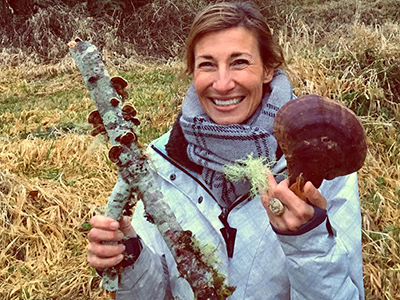
But if you don’t want to forage, identify, dry, extract, strain, and bottle it yourself, Nicole already made the easier version.
Her usnea remedy is made with organic or wild-harvested usnea, and the spray format makes it especially practical for toenails because it can reach tight areas where a thick salve may not spread as easily.
Check out her Usnea Tincture Spray here.
3. Salve for Bug Bites & Itchy Skin: Plantain + Chamomile
Mosquito bites have a strange talent.
They can be tiny enough that nobody else notices them while somehow occupying 90% of your attention.
Before you scratch the skin raw, reach for something cooling.
Broadleaf plantain has a long history as a quick topical herb for bites and itchy skin. Its leaves are traditionally crushed and placed directly over irritated areas.
For something you can keep ready year-round, turn it into a salve.
Combine:
- Plantain-infused oil
- Chamomile-infused oil
- Calendula
- Olive oil
- Beeswax
Apply a small amount as soon as you notice the itch.
This is the kind of salve that earns a permanent place next to the back door during mosquito season.
If a bite causes severe swelling, difficulty breathing, dizziness, or rapidly spreading symptoms, however, that is no longer a job for your herb cabinet.
2. Salve for Everyday Skin Mishaps: Calendula + Plantain + Yarrow
If you garden, cook, hike, clean, or simply work with your hands, your skin eventually collects the evidence.
A scrape here. A bug bite there. A rough patch that suddenly feels irritated.
That’s why a few plants combined together can become your all-purpose herbal salve and can earn permanent space in your cabinet.
Calendula has long been used in topical preparations for irritated skin, while plantain is a classic herb for itchiness and minor skin discomfort. Yarrow is another traditional favorite for everyday skin mishaps, and Balm of Gilead has a long history in soothing topical preparations.
A versatile salve might combine: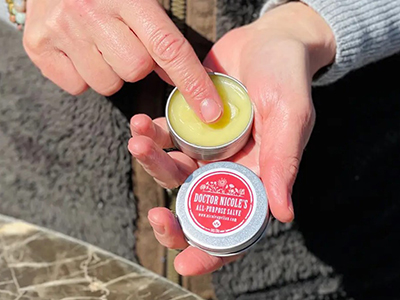
- Calendula-infused oil
- Plantain-infused oil
- Yarrow
- Balm of Gilead or cottonwood buds
- Lavender
- Olive oil
- Beeswax
The beauty of this kind of blend is that you don’t need a completely different remedy for every little thing. You can keep one tin close by for the minor scrapes, bites, chafed spots, and irritated skin that tend to show up when you least expect them.
Clean the area first, then apply a thin layer as needed.
This is also a very practical salve to make in advance. Once the herbal oils are infused and blended with beeswax, you have something simple and ready to reach for whenever everyday skin trouble pops up.
Still, a long list of traditional plants does not help much when making the salve feels like the hard part.
You need the herbs, the infused oils, the beeswax, the right texture, the jars, and the patience to get it right.
That is where most people quit and reach for a lab-made cream instead.
So I’ll leave the easy version here too.
Click here for a ready-made herbal salve with calendula, plantain, yarrow, Balm of Gilead, lavender, olive oil, beeswax, and other skin-supporting ingredients already blended for you.
For deep cuts, puncture wounds, badly contaminated wounds, significant burns, or anything showing signs of infection, seek appropriate medical care.
1. The Traditional “Black Drawing” Salve: Activated Charcoal + Plantain
Few old-fashioned remedies attract as much curiosity as drawing salve.
Traditionally, people used dark salves containing charcoal, clay, herbs, and oil on splinters, irritated spots, and other minor skin problems.
Activated charcoal certainly has impressive absorbing properties. It is even incorporated into some modern wound dressings, particularly to help control odor and bind material within the dressing.
But this needs an important distinction.
Charcoal does not magically pull infections or mysterious “toxins” out through your skin.
A gentle traditional charcoal salve might contain:
- Activated charcoal
- Bentonite clay
- Plantain-infused oil
- Calendula-infused oil
- Beeswax
You might use a small amount around a superficial splinter or irritated spot, then cover the area with a clean bandage.
But never confuse this kind of herbal charcoal preparation with corrosive products sometimes sold as “black salve.” Products containing ingredients such as bloodroot and zinc chloride can destroy healthy tissue and have been specifically warned against by health authorities.
If a wound contains pus, becomes hot, increasingly painful, swollen, red, or develops red streaks, do not try to “draw it out.”
Get it checked.
This is one of those old recipes you really want to see, not just read about.
The dark color. The texture. The way the ingredients come together. It makes much more sense when you have the full recipe with images in front of you.
And this one comes from a different old-skills book I’m sharing on The Lost Herbs for the first time — a practical guide filled with illustrated, hands-on recipes and skills our grandparents would have understood immediately. 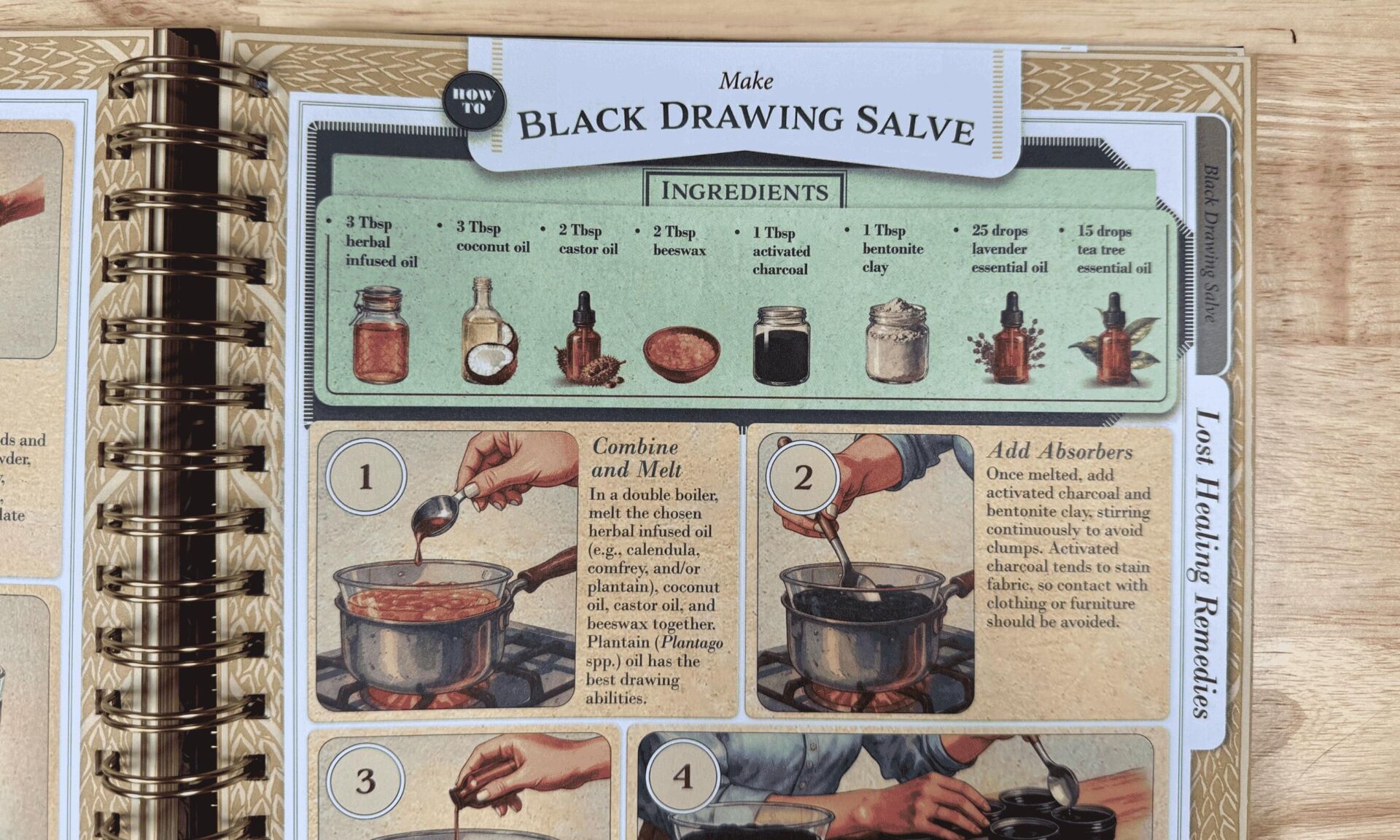
Click here to read more about this new information and see the full salve recipe with images.
Aaand here it comes, below I’d like to share with you something that has never been posted around here.
One Salve Base, Dozens of Uses
Once you understand the basic technique, making a salve becomes surprisingly straightforward.
A traditional starting point is roughly:
4 parts herbal-infused oil to 1 part beeswax.
Gently melt the beeswax in a double boiler, stir in your infused oil, then allow a drop to cool on a spoon.
Too soft? Add a little more beeswax.
Too hard? Add a little more oil.
That one method can become an arnica rub, calendula skin salve, plantain bite balm, peppermint foot rub, or dozens of other preparations simply by changing the herbs.
And that is perhaps the most useful lesson of all.
You do not need 30 complicated products sitting in a bathroom cabinet.
Sometimes you simply need to understand a handful of plants—and know where on your body they make the most sense.
The Old Skills Are Still Useful
This article is really about more than salves.
It is about remembering that our grandparents and great-grandparents knew how to make useful things with their own hands.
A skin salve. A poultice. A remedy for a bite. A way to keep food longer. A way to handle small problems before running to a store.
That kind of independence used to be normal.
Now, most of it has been buried.
That is why I wanted to share The Lost Skills of Independence with you.
Claude Davis gathered 200 practical life skills into a beautiful hardcover, spiral-bound book with full-color illustrations and step-by-step instructions.
It covers natural remedies, food preservation, water, DIY projects, emergency skills, home independence, and old-fashioned know-how that people used before everything depended on modern systems.
I also managed to get approval to show you what it looks like inside, because the layout is honestly one of the best parts: each skill is illustrated, easy to find, and simple to follow while your hands are busy. 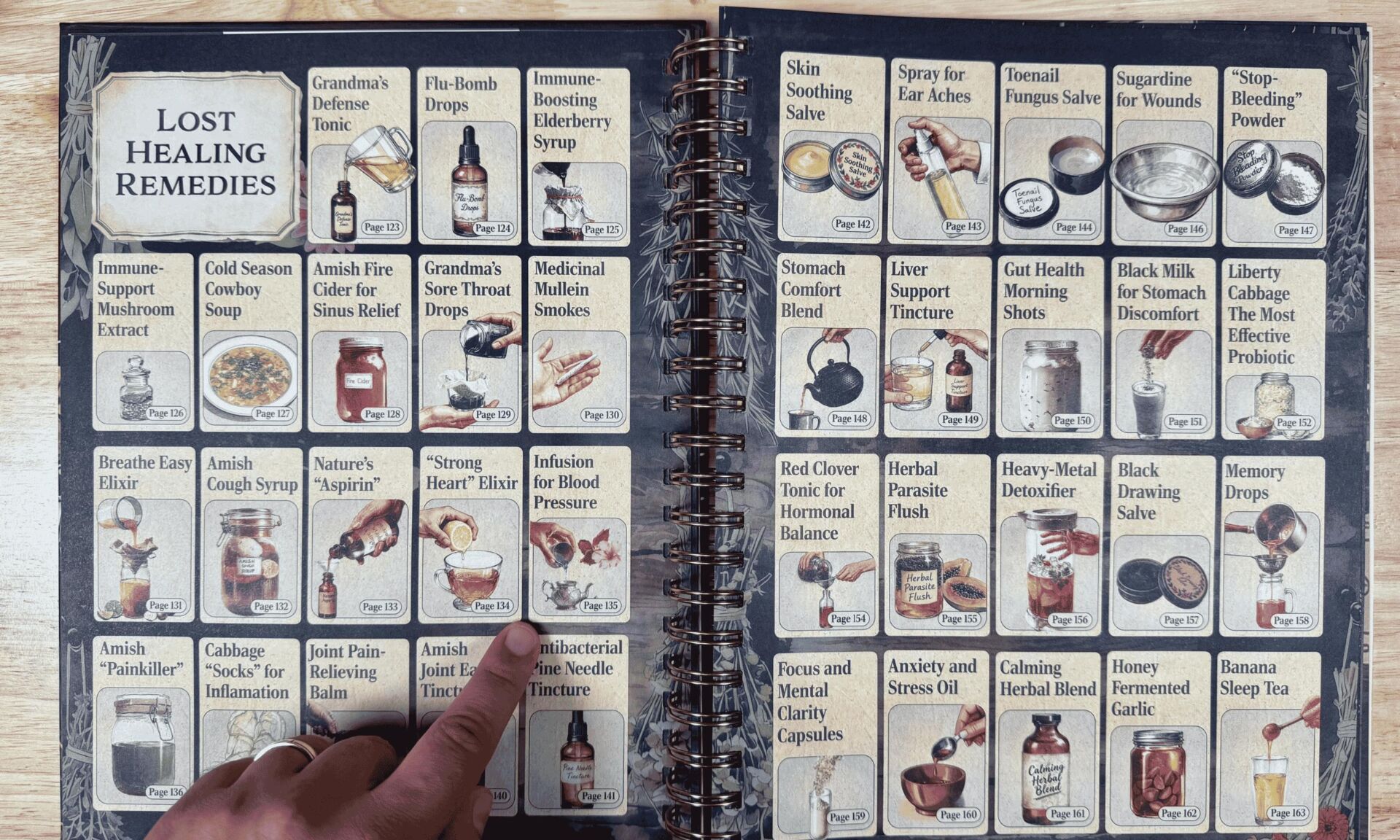
If you like the idea of making your own salves, you’ll probably love what else is inside this book.
Click here to see The Lost Skills of Independence and the 200 skills inside.
You May Also Like: 
Learn More About Herbal Remedies In Our Facebook Herbal Group!
Flu, Viral, and Immune System Protocol (Video)
How to Dry Herbs – A Complete Beginner’s Guide
How to Grow Herbs in Water – Your Complete Guide to Soil-Free Herb Gardening
A Quick Safety Note: Plants can be wonderful allies for everyday skin care. Just patch-test new salves first, dilute essential oils properly, and keep strong oils away from sensitive areas. And if something looks serious, spreads, becomes very painful, or doesn’t improve, please get it checked. Herbal remedies are best used with care, respect, and common sense.
References
Cleveland Clinic — Arnica: What It Is and How To Use It https://health.clevelandclinic.org/arnica
Calendula officinalis and Wound Healing — Systematic Review https://www.researchgate.net/publication/333494992_A_systematic_review_of_Calendula_officinalis_extract_for_wound_healing
Brooklyn Botanic Garden — Broadleaf Plantain https://www.bbg.org/article/weed_of_the_month_broadleaf_plantain
Medical News Today — Tea Tree Oil for Nail Fungus https://www.medicalnewstoday.com/articles/326900
National Center for Biotechnology Information — Aloe Vera and Burn Wound Healing https://www.ncbi.nlm.nih.gov/books/NBK74820/
Association of Accredited Naturopathic Medical Colleges — Peppermint Oil and Headache Relief https://aanmc.org/naturopathic-medicine/migraine-pain-relief/
Healthline — Lavender and Relaxation https://www.healthline.com/health/anxiety/lavender-for-anxiety
WoundSource — Activated Charcoal Dressings https://www.woundsource.com/blog/wound-odor-management-charcoal-wound-dressings
Activated charcoal works great to immediately relieve itchy bug bites and poison ivy. Scratch the place first, then sprinkle on some charcoal powder and cover with a bandaid.
Something i really want to know but can’t find the information on anywhere. Once you’ve melted beeswax in a pot (i use a double boiler) how do you go about getting any remaining wax residue out? I often find this difficult and can never seem to get it completely clean. What do you do?
I picked up a little pot with a handle on it and a pouring spout. I melt my wax in this over some boiling water and pour what I need. I don’t care about the residue because that’s the only thing I use this little pot for. I just leave the residue in it and it will melt the next time